When you click on links to various merchants on this site and make a purchase, this can result in this site earning a commission. Affiliate programs and affiliations include, but are not limited to, the eBay Partner Network.
just did my first proper off road rock crawling test with the defender. i was worried about the stock goodyear all terrains - as some have reported weak sidewalls on rocky terrain. i aired down to 37psi all the way around (on stock 18" steelies). i was honestly VERY surprised at how well they did, grip was abundant - even when 3 wheeling. the camera system was great for me to place the tread on the rock versus brushing up against the sidewall.
I appreciate this post (along with many of yours).
My primary off-road use is probably a little unique (well it is on the Jeep forum, maybe less so on the JLR forum). It's deep, loose, rutted sugar-sands in the Outer Banks.... the beach and dunes necessary to get in and out of the houses on the 4x4 section.
In the decade or more we've been frequenting a family house there (generally for a week or more multiple times a year) I rarely visit without helping get a few vehicles unstuck. And those vehicles, often include Land Rovers who haven't aired down (or pickup trucks who didn't, or SUVs who didn't, and the occasional Jeep owner who forgot to put it in 4WD).
Anyway, I don't doubt JLR's experience running deserts at high speeds etc, but it airing down does seem critical in the OBX and truthfully is the most common reason people get stuck.
Not to mention (and this is just a technicality) it's actually required by law to air down < 20 psi (not that I've ever heard of someone getting a ticket for not).
Anyway, we have aired down the OEM Pirelli Scorpions (on 19" wheels) for a week at a time (though confession I'm not fully in compliance with the law keeping it in the low 20's psi). During such time we drive up and down the beach, across the dunes back and forth to the house, and once in a while a couple of miles back on the pavement to the markets, shops, restaurants. Everything below maybe 30-35 mph at max, most of it a good bit slower. The Defender has, as you would expect, performed flawlessly. Maybe I'm fooling myself and perhaps I should just try it next time fully aired and see, I can always stop and air down if it starts to dig in instead of making progress. Especially if it's early in or before season as there is very little LEO presence at those times.
I'm glad you find my posts helpful.
Very nice looking beach as well as D110 color combination.
Providing there's nothing hiding beneath the sand you might be able to get away with those pressures on the 19" with caution, but I'd be careful about fast turns or sliding sideways (could pop the tyre off the rim). Based on the look that beach the conditions don't seem too bad so I wouldn't worry about running at 32psi/2.2 Bar. More important is proper technique and many people don't understand how to drive on sand in a 4x4.
If you want to see some tough sand conditions check out Fraser Island in Australia:
@insider On a different note, could you comment on the use of the screw on rear towing eye for recovery purposes? I know the manual says it is not meant for off road recovery, but given the fact that fixed recovery points are an accessory option, is it really that simple?
You can use the rear recovery eye in an off-road situation with extreme care. However, because of the recovery eye length and means of attachment it isn't intended to withstand side forces like the loops can easily tolerate. When a recovery vehicle tows you on pavement it's generally making a direct pull onto a flatbed of some sort, but off-road a heavy tug at awkward angles may be required. That recovery eye places a tremendous load at the joint when torqued to the side. This problem doesn't exist with the loops.
In summary- if you are pulling in a straight line away from the vehicle and not at an angle and you don't apply any sudden force it will be fine. If you pull at the eye at an angle with sudden force you have a good shot at fracturing the mount.
I highly recommend the loops at they are rated for over 14,000 pounds/6,400 kg and can handle any angle of attack without strain. Honestly, they'll handle more than that, but we keep our ratings on the conservative side.
This sounds like our typical experience in Nantucket. In my case, I had just left the hard-packed "parking area" to go through a vehicle access point between two dunes. The Defender seemed to sink within a few feet and we stopped making any forward progress (this is leaving the tires at the factory tire pressure of 47-50 psi). I tried the low traction launch, but it did not get us going (I admit I may not have done that correctly...just followed the on-screen instructions). I was able to back straight out.
It sounds like airing down to the low-30s is what I should do.
Adjust your technique. You need to carry plenty of momentum and power in sand (but not so much you're spinning the tires and digging into the sand). When you feel your progress starting to slow to the point where a full stop is imminent immediately back off and go backwards (create a ramp). Never start spinning your tyres in sand-it's always counterproductive.
I'm sure people on this forum will disagree, but I am adamant that if you are getting stuck with standard pressure on low profile tyres you will get stuck with low pressure as well. Low pressure makes things easier but it doesn't solve fundamental problems with a driver's approach. I encourage everyone to watch some videos on proper sand technique that some of the Aussies put together. You need to approach sand driving with a plan and learn to read the surface.
Very nice looking beach as well as D110 color combination.
Providing there's nothing hiding beneath the sand you might be able to get away with those pressures on the 19" with caution, but I'd be careful about fast turns or sliding sideways (could pop the tyre off the rim). Based on the look that beach the conditions don't seem too bad so I wouldn't worry about running at 32psi/2.2 Bar. More important is proper technique and many people don't understand how to drive on sand in a 4x4.
Plenty of videos of stuck 4x4's at that location (including ours).
Ha ha noted but don't get fooled by that pic on the barely driven low tide area.
The conditions in that video are very familiar. Trust me we've been going to the house here for 10+ years. Especially in season the loose, deep, sugar sand gets rutted and quickly swallows the unprepared, even the giant redneck trucks.
Yes this early in the year with little traffic that pic near low tide doesn't look bad, but cross a couple of dunes to get to the houses or run the dune line at high tide and it's a much less forgiving surface (much like that video).
I remember coming back from dinner one night in the Wrangler with the Track-Lok LSD rear and M/T tires, we started to climb the dune and it started to dig in. I stopped immediately, looked sheepishly at my wife, and casually shifted it into 4WD, backed up, then took another run at it easily making it home with only a few minor bruises on the ego.
But don't worry I'm only a kid at heart these days and we don't go sliding around the beach. And in season the ancient forest that's under this beach is well covered though we still watch got stumps in some areas, even in summer. It's more gnarly in the winter.
Some pics for amusement:
Not too badly stuck Land Rover:
Off-season / low tide obstacles:
And have I mentioned the water holes (stuck wild horse tour):
Very nice looking beach as well as D110 color combination.
Providing there's nothing hiding beneath the sand you might be able to get away with those pressures on the 19" with caution, but I'd be careful about fast turns or sliding sideways (could pop the tyre off the rim). Based on the look that beach the conditions don't seem too bad so I wouldn't worry about running at 32psi/2.2 Bar. More important is proper technique and many people don't understand how to drive on sand in a 4x4.
I'm quite late to this thread I'm afraid, but I feel it's important to address this topic. At JLR it was very painful for us to watch the TFL video in which they experienced multiple flat tyres on the trail with their new Defender. The video received many views and misled perhaps millions about our vehicle. The tyres on that vehicle were NOT running the appropriate pressure and thus easily pinch-flatted on a rock.
I can't emphasize enough that you DO NOT lower the pressure on low-profile tyres. Period. You need sufficient sidewall height to do this and low-profile tyres do not possess this sidewall height. I define low profile tyres on an SUV as anything with less than 7" (180mm) of sidewall height. You can manipulate pressures and go below factory pressures with 18" wheels, but the 19-22" wheels should stick to comfort settings. 2.2 Bar/32psi is the bare minimum, but you'd be safer at 2.3Bar/34psi.
More importantly, there is very little to be gained on a low profile tyre by doing this. Traction is a function of surface area, vehicle weight, compound, tread, etc. I can assure you that our terrain response systems are calibrated to deal with the tyres at factory recommended pressures.
When you see press videos or films of our vehicles flying across deserts or climbing through remote parts of the African continent- I can assure you we are not running low pressure.
Couple of thoughts you can pass up the food chain:
1) How about putting this in the owners manual and on a sticker in the door jamb where the pressures are .
2) Or… the TPMS system can flag a warning message when it senses multiple tires being aired down within a short period of time
3) The Integrated Air Compressor in the cargo area - put a sticker on it saying “do not air down the stock tires….”
I quite literally was on a dealer trip where L663’s with 20’s were aired down. I don’t think this has been adequately communicated.
Last edited by nashvegas; Mar 16, 2022 at 09:28 AM.
Couple of thoughts you can pass up the food chain:
1) How about putting this in the owners manual and on a sticker in the door jamb where the pressures are .
2) Or… the TPMS system can flag a warning message when it senses multiple tires being aired down within a short period of time
3) The Integrated Air Compressor in the cargo area - put a sticker on it saying “do not air down the stock tires….”
I quite literally was on a dealer trip where L663’s with 20’s were aired down. I don’t think this has been adequately communicated.
Agree. If JLR watched the TFL debacle with such dismay, why didn’t the company come with official guidance to owners? Knowing that airing down is gospel in the “wheeling” community, why didn’t they address this at the outset when spec’ing low profile “off-road” tires and wheels on the Defender? I was fortunate to learn from my LR experience instructor to leave tire pressure up at heavy load level for off-road, but nobody seems to ever believe me. Would be nice to have that in an official announcement or iguide update. On beaches though, we had to go down to 20 on our 20’s to get past ranger station where they were checking pressures and equipment one day. Did fine, but I’d also be fine trying it at 32 next time I’m there if the rangers aren’t checking.
Insider, really useful info appreciated. Thx. Do you have any best suggestions to read or see more on technique for sand.
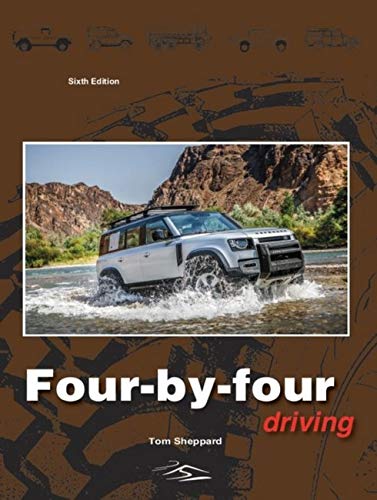
In terms of books on off-roading to teach fundamentals and theory (that you can connect back to your Land Rover) I'd probably take a look at the Tom Sheppard series of books that have been around since the late 1990's. Tom is considered one of the most knowledgeable people in the world when it comes to expeditions and off-road theory. His 6th edition is out now and has an L663 on the cover, so I suspect he's addressed some of the newer technology.
There are some older Land Rover videos out there floating around from 14 years ago shot with a Discovery 3 and L322 RR but they are a bit out of date. Unfortunately, I don't have time to go through all the videos out there, but maybe this weekend I'll take a look.
We recommend that everyone take an opportunity to visit one of our Land Rover Experience centers located in the US, UK, Germany, Austria, France, Spain and Italy to name a few more popular destinations. You can learn a great deal about how to use your vehicle properly.
Many will be surprised to find a few button presses will free you when you're stuck in the sand using ATPC (without the need for a shovel).
Couple of thoughts you can pass up the food chain:
1) How about putting this in the owners manual and on a sticker in the door jamb where the pressures are .
2) Or… the TPMS system can flag a warning message when it senses multiple tires being aired down within a short period of time
3) The Integrated Air Compressor in the cargo area - put a sticker on it saying “do not air down the stock tires….”
I quite literally was on a dealer trip where L663’s with 20’s were aired down. I don’t think this has been adequately communicated.
1) There are far too many variables to be placing a specific off-road pressure on the door jamb. Your tire size, terrain, load and driving speed dictate your needs. I know the public likes everything in black and white, but there are too many variables to recommend a specific pressure. This falls into the category of -if you have to ask you probably need more training/knowledge. In very specific circumstances you might be able to get away with 22psi/1.5Bar on a low profile tyre, but for most circumstances people will be safe at 32psi/2.2 Bar.
Honestly, there's legal issues at play as well. If a family puts 22psi/1.5 Bar in their tyres (at our recommendation) and goes off-roading with the kids and then fail to return the tyre pressure to proper levels before a 80 mile journey home in fast road traffic on winding roads and they have an accident- that's going to be on us.
2) We don't want people forgetting the pressure is down. Sorry, people are too forgetful and the US is far too litigious.
3) You can air down the stock tyres, but you should do it according to your needs and conditions. I suggested people do not go below 32psi/2.2 Bar which is far below the recommended pressure on the doorjamb. If you happen to be a rare remote location where you have miles of pure sand, no rocks or submerged obstacles and you will drive with care/caution then you can go ahead and try 22psi/1.5 Bar on a 19" or 20" tyre. People are rarely in that situation though.