When you click on links to various merchants on this site and make a purchase, this can result in this site earning a commission. Affiliate programs and affiliations include, but are not limited to, the eBay Partner Network.
Started her up today. Ran really well, was running high temps, but have to really had a chance to get all the air out. Everything looks good, but the damn Throttle Body Heater is leaking. So I ordered a kit and will get that done this week.
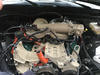
Here is the final product.
I like the look, but no way would I do the hood insulation. It's already too hot inside that engine bay.
Might consider some side+high-up fender cutouts like Range Rover installed later (to help the engine bay breathe).
Hate to be a kill joy, but there is a reason they don't paint aluminum engines (heads and block). Aluminum has a thermal conductivity three times greater than case iron. It's all about heat transfer. There is what is called a "boundary layer", which mates with the cooling fluid and ambient air under the hood. These two areas decide how the engine will be cooled. When you obstruct the outer boundary, by painting, you are in essences partially limiting the aluminums ability to transfer heat externally. Which in turn, causes the fluid side to do more work in that area.
Learned a lot about this in a three week course put on by Allison Transmission/Detroit Diesel. They talked extensively about "why" aluminum should never be painted. Allison transmission will reach temps close to 300F, so displacing heat is paramount.
Like I said...hate to be a Debby-downer...but this is just something I learned and thought l'd pass it along. Hate to see this practice become common place and folks start seeing even worse cooling issues.
Hope this isn't the case on your engine, but time will tell.
Brian.
He can probably get away with painting the throttle body intake upper area and removing the throttle body heater plumbing, plus painting the alternator and A/C brackets as well as polishing the alternator. Probably no harm in painting the heater pipes!
Temps may force him to remove the paint elsewhere, but his testing will show that, if so.
Last edited by No Doubt; May 19, 2018 at 10:08 PM.
He can probably get away with painting the throttle body intake upper area and removing the throttle body heater plumbing, plus painting the alternator and A/C brackets as well as polishing the alternator. Probably no harm in painting the heater pipes!
Temps may force him to remove the paint elsewhere, but his testing will show that, if so.
Yes, the majority of external heat transfer is probably going to happen in the block (which I believe didn't get painted, so that's a plus...in my opinion). Heads have minimal external transfer, since only one side is exposed to ambient air and hot exhaust gases are being taken away through the exhaust manifolds.
Now, you'll see a lot of street rod guys paint their aluminum engines, to get an authentic look. But, in most of these cases they are dealing with a much larger cooling system (three or four core radiators, big open engine bays, better designed cooling systems, etc). So, cooling efficency is not so critical.
Would be interesting to see if the painted intake helped, harmed or made no difference in performance. Might keep the manifold shielded from engine bay temps and allow intake air to remain cooler upon entry. Maybe, maybe not?
Anyhow, engine looks great and l hope everything turns out okay.
Hate to be a kill joy, but there is a reason they don't paint aluminum engines (heads and block). Aluminum has a thermal conductivity three times greater than case iron. It's all about heat transfer. There is what is called a "boundary layer", which mates with the cooling fluid and ambient air under the hood. These two areas decide how the engine will be cooled. When you obstruct the outer boundary, by painting, you are in essences partially limiting the aluminums ability to transfer heat externally. Which in turn, causes the fluid side to do more work in that area.
Learned a lot about this in a three week course put on by Allison Transmission/Detroit Diesel. They talked extensively about "why" aluminum should never be painted. Allison transmission will reach temps close to 300F, so displacing heat is paramount.
Like I said...hate to be a Debby-downer...but this is just something I learned and thought l'd pass it along. Hate to see this practice become common place and folks start seeing even worse cooling issues.
Hope this isn't the case on your engine, but time will tell.
Brian.
Well, we will see. I took the parts to Performance Auto Parts and Machine, and while the guy is not an engineer, he knew everything about these motors (seemingly every motor) and he had no issue painting the heads for me. The guy has decades of real world experience, and if there were an issue with painting the heads at a practical level he'd have told me about it. He gave me lots of advice on the paint, engine and install.
Yes, the majority of external heat transfer is probably going to happen in the block (which I believe didn't get painted, so that's a plus...in my opinion). Heads have minimal external transfer, since only one side is exposed to ambient air and hot exhaust gases are being taken away through the exhaust manifolds.
Now, you'll see a lot of street rod guys paint their aluminum engines, to get an authentic look. But, in most of these cases they are dealing with a much larger cooling system (three or four core radiators, big open engine bays, better designed cooling systems, etc). So, cooling efficency is not so critical.
Would be interesting to see if the painted intake helped, harmed or made no difference in performance. Might keep the manifold shielded from engine bay temps and allow intake air to remain cooler upon entry. Maybe, maybe not?
Anyhow, engine looks great and l hope everything turns out okay.
Brian.
I will be doing a post-mortem thread after a little time, and a good long road test. I will post mpg's, temps in comparison to what they were. I ported the intakes, heads and manifolds a bit so I am interested in any changes.
The temps will be interesting, my truck has always run at 200-204 highway. I have electric fans so I watch this stuff.
This is kind of what I am guessing happens on the heads, but we'll see. The Duplicolor engine paint has shown to be really durable on my steering shaft, and Box where it gets caked in grease, and grime. I am interested to see how it holds up on the heads.
I also used Eastwood Manifold paint on the manifolds so I will be interested to see how long that lasts. Boy, when that cures it smokes like crazy.
I only used the paint, not primer or clear on the alternator pulley. My thoughts are the priming and clearing I did were a waste of time and money. More time than money, but we will see.
Yes, the majority of external heat transfer is probably going to happen in the block (which I believe didn't get painted, so that's a plus...in my opinion). Heads have minimal external transfer, since only one side is exposed to ambient air and hot exhaust gases are being taken away through the exhaust manifolds.
Now, you'll see a lot of street rod guys paint their aluminum engines, to get an authentic look. But, in most of these cases they are dealing with a much larger cooling system (three or four core radiators, big open engine bays, better designed cooling systems, etc). So, cooling efficency is not so critical.
Would be interesting to see if the painted intake helped, harmed or made no difference in performance. Might keep the manifold shielded from engine bay temps and allow intake air to remain cooler upon entry. Maybe, maybe not?
Anyhow, engine looks great and l hope everything turns out okay.
Brian.
The block is bare. I can't see how the intake could affect overall engine temp. I doubt that the paint has any effect on the intake temps, but if they are a bit cooler, Great!