When you click on links to various merchants on this site and make a purchase, this can result in this site earning a commission. Affiliate programs and affiliations include, but are not limited to, the eBay Partner Network.
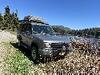
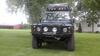
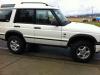
Bringing this over from Expedition Portal. Moving along with the Honda Odyssey wheel experiment, so far so good. With some questions maybe other 235/85-16 tire people might have answers too. As for the wheels, I bought one, machined out the center bore to 70.1mm and mounted one tire. Fit seems to be pretty good. No rubbing. The Honda wheel is at 50mm vs. 57mm stock for offset so outboard 7mm, not much. Keep in mind the truck thus far is stock height with tired springs at 175k. I have searched and read every 235/85 Disco thread I can find and there are plenty. It's supposed to be a decent tall and skinny size for the D2. Some even say ok at stock height although I have my doubts. I plan to lift it either 2-3" so that's not a problem. My question is on tire weight. These tires are heavy, like 18lbs per wheel/tire corner heavier than stock. How has that affected the driveability or does it? Plenty of info on the size difference and that's understandable, but weight? My other question is if anyone knows the stock scrub radius for a D2. I have looked everywhere and cannot find anything. According to online calculators this combo will move the SR to the negative about 1/8" but I don't know the stock spec to start from.
First photo (rear) is with the body jacked up about 2" to simulate a lift
FYI - The wheel is for a Honda Odyssey Minivan so GVWR is nearly identical to the D2. Wheel spec is 7x16 5x120 64.1mm CB 50mm offset
Yep, extra spinning mass weight = more energy to spin the mass weight = more fuel to create that energy. That's why the industry went away from steel rims, aluminum offered lighter rims and decreased the amount of spinning mass. You'll see a similar affect when switching from a passenger/SUV type tire to a LT type tire. LT = heavier sidewall, more plies = more weight = lower fuel mileage. Wider tires also affect fuel mileage, but that is caused by more resistance with wind and road surface.
I noticed a minute/small loss of power when I switched to 235/85-16 due to the taller profile tire. That was 6-7 years ago. I have a 2" lift. The 235/85 was the tallest skinny tire I could find.
Thanks for the info Motorhead! Any clearance issues with the 2" lift and 235/85? I keep going between 2" and 3". Leaning more towards only 2" if it clears ok.
I'm really interested in what you did with the wheels on this. Did you just have them machined to 70.1 and they fit the hub?
That was the the first plan. Taken to 70.1 leaves a sliver of metal from the flange. I had them taken out to 73.1 and used a spacer. So far everything is working great. I like the tire size and have not noticed any real performance drops due the size. MPG is mostly the same (12-13 in town) a little slower on acceleration from a dead stop. I have mud tires which is excessive for a dd but I knew that going in. With all terrain tires this would be even better.
Okay, that makes sense. I was thinking there's not a lot of meat in the center there to be taken out. So you're just using hub centering rings (spacers) to cover that gap? It seems like those wheels would work as both hub centric with the rings and lug centric with the tampered lug nuts too so that's nice. My only concern would be that center hub area cracking since there's no longer a raised lip on the center bore of the wheel. Might not really be an issue though. Did you have a machine shop do the boring of the centers?
Okay, that makes sense. I was thinking there's not a lot of meat in the center there to be taken out. So you're just using hub centering rings (spacers) to cover that gap? It seems like those wheels would work as both hub centric with the rings and lug centric with the tampered lug nuts too so that's nice. My only concern would be that center hub area cracking since there's no longer a raised lip on the center bore of the wheel. Might not really be an issue though. Did you have a machine shop do the boring of the centers?
i'm not worried about the wheels. No material was removed from the clamping pad area. If secured correctly, which they are, clamping force is doing its job. In my experience driving for 40 years wheels fail for two reasons, they come loose or hit something.
I had a machinist do the final work. The start of the project was a bit ugly as I thought I could do it myself with a centering jig. I was wrong. If I had a expert do it to start with I might have been able to make 70.1 work keeping some of the center lip.



 Honda steelie 235/85-16 project