When you click on links to various merchants on this site and make a purchase, this can result in this site earning a commission. Affiliate programs and affiliations include, but are not limited to, the eBay Partner Network.
My mind is cluttered with LR3 lift options, please advise:
FYI - I'm a new Forum member and this is my first post, if I'm jumping in incorrectly advice is welcome with this as well.
To Summarize: I am an original owner of a 2006 LR3, gave it to my daughter, bought my wife an LR4, myself a Range Rover Sport. I just sold the Sport (useless vehicle), bought my daughter a new car, and took back the LR3, AND I'VE NEVER BEEN HAPPIER! I am NOT mechanically inclined (I am when I have to be) so much of the tech talk in the forum is over my head. The LR3 is in great condition on it's way to becoming an original OEM classic, but I've decided to do a trail build and need help on the best / safest / most reliable lift option.
Here are bullet points, I need help seeing the trees through the forest:
* Johnson Rods; quick, cheap and visually satisfying lift - but my Land Rover tech (who I trust with my life) says not a sound option especially when it comes to trail failure on the trail and alignment issues, thoughts?
* Pro's and Cons of Proud Rhino SYA Extension Kit?
* Gap tool; what's the different about its height adjustment option verses the LR3's own lift operations?
* 30mm Spacers; is there a situation where spacers are good, bad or indifferent etc?
* I want 32" (or +) tires but do not want to jeopardize long term damage to the vehicle or off road reliability.
Please share your advice (and explain it to me as if I was a two year old), any input is great appreciated.
Gap tool is a must but if you aren't doing your own repairs/maintenance it may not be of value to you. Go for an electronic lift and forgot about rods or extension kits , again forget spacers unless you want to fit large rubber.
265/65/18 is nearly 32" or 275/65/18 if you want a little more rubber, the 265/65 will fit underneath ( deflated) but the 275/65 wont.
I wish you numbered your points, easier to respond.
1 - Rods. I already like your tech, they are smarter than most and I agree with them. They are cheap, easy but can indeed cause problems. That includes pushing the sensors past their range when tucking a wheel up such as when rock crawling. They are more suited for mall crawlers and the like. They work, but... So yeah, what loanrangie said basically.
2 - When you lift the struts you are simply moving the "window" the struts travel. Meaning physically, relative to vehicle, the tires can go a little lower. While they also prevent the tires from tucking up too far. So like loanrangie said, they are only useful with larger oversized tires - which are NOT the practical way to go anyway. I run larger and get by with the skin of my teeth. Larger yet would just hurt me more and I did not even want this size anyway. Bigger tires = more stress, more wear and more issues. You can only push tire size so far, practically.
3 - The GAP tool is not a lift tool, it is MUCH more than that. But when it comes to lift it basically adjusts the working points of the factory heights. So say you adjust stock height to + 1.5". That means your off-road height will be higher and so will access height. But in now way will the sensors themselves be pushed out of range. So its really just a calibration adjustment and you can even preset them in the tool and apply them when off-roading only, for example.
4 - Spacers are not ideal. They add leverage to the hubs/bearing and can cause them to wear faster. Spacers are only ideal for correcting a wheel, not pushing it outwards. In fact, spacers can CAUSE rubbing issues. For example, if you tuck the wheel up a spacer may cause the tire to rub on the fender flare. Or it may cause wear on the wheel liner on the outside when in a full turn.
5 - See above. Bigger tires reduce economy, torque and the additional weight will cause some additional suspension wear. Nothing catastrophic if you stay reasonable, but nonetheless it's happens. 32" is about as big as you can go without much modification. And this can actually depend on the tire you get. Some 32"s like mine, are fine. But some like my buddy with mud tires had issues. Every tire manufacture is a little different in actual size. I run 275/65/18 which is 32.1" by 10.8" on an 18. Skinny tires usually win the battle. Wider tires look cool but are, in fact, not practical in a lot of situations. Think of the old Jeeps/Rovers. Tall and skinny tires. I am waiting for a 5th rim and have to order a spare (I got my tires about a month ago and switched from 19s to 18s). It should fit with some work in the spare tire area. I did have to slightly modify my passenger rear wheel well liner, just used a heat gun to push it inward. But I did not have to move my coolant lines. A size that works well though is 285/60/18 <--- That was the "go-to" size when the LR3 was new and no mods are needed in any way. Best "safe" large tire size, https://tiresize.com/comparison/
With all that said, NOTHING will be worth doing if your overall suspension is worn. The bushings dont last forever and the slop can really add up to poor handle. Larger tires and height adjustments can make it all worse. In fact, if you are setting a new standard height you should loosen ALL suspension bolts, not just the ones related to alignment. It allows the bushings to rotate/slip into a new home position instead of forever being twisted, which of course causes much faster failure.
I should that even without doing your own repairs a Gap tool can help if you get faults out on a trail and need to clear them to get moving again, with the added benefit of suspension adjustment they are worth the investment.
I wish you numbered your points, easier to respond.
1 - Rods. I already like your tech, they are smarter than most and I agree with them. They are cheap, easy but can indeed cause problems. That includes pushing the sensors past their range when tucking a wheel up such as when rock crawling. They are more suited for mall crawlers and the like. They work, but... So yeah, what loanrangie said basically.
2 - When you lift the struts you are simply moving the "window" the struts travel. Meaning physically, relative to vehicle, the tires can go a little lower. While they also prevent the tires from tucking up too far. So like loanrangie said, they are only useful with larger oversized tires - which are NOT the practical way to go anyway. I run larger and get by with the skin of my teeth. Larger yet would just hurt me more and I did not even want this size anyway. Bigger tires = more stress, more wear and more issues. You can only push tire size so far, practically.
3 - The GAP tool is not a lift tool, it is MUCH more than that. But when it comes to lift it basically adjusts the working points of the factory heights. So say you adjust stock height to + 1.5". That means your off-road height will be higher and so will access height. But in now way will the sensors themselves be pushed out of range. So its really just a calibration adjustment and you can even preset them in the tool and apply them when off-roading only, for example.
4 - Spacers are not ideal. They add leverage to the hubs/bearing and can cause them to wear faster. Spacers are only ideal for correcting a wheel, not pushing it outwards. In fact, spacers can CAUSE rubbing issues. For example, if you tuck the wheel up a spacer may cause the tire to rub on the fender flare. Or it may cause wear on the wheel liner on the outside when in a full turn.
5 - See above. Bigger tires reduce economy, torque and the additional weight will cause some additional suspension wear. Nothing catastrophic if you stay reasonable, but nonetheless it's happens. 32" is about as big as you can go without much modification. And this can actually depend on the tire you get. Some 32"s like mine, are fine. But some like my buddy with mud tires had issues. Every tire manufacture is a little different in actual size. I run 275/65/18 which is 32.1" by 10.8" on an 18. Skinny tires usually win the battle. Wider tires look cool but are, in fact, not practical in a lot of situations. Think of the old Jeeps/Rovers. Tall and skinny tires. I am waiting for a 5th rim and have to order a spare (I got my tires about a month ago and switched from 19s to 18s). It should fit with some work in the spare tire area. I did have to slightly modify my passenger rear wheel well liner, just used a heat gun to push it inward. But I did not have to move my coolant lines. A size that works well though is 285/60/18 <--- That was the "go-to" size when the LR3 was new and no mods are needed in any way. Best "safe" large tire size, https://tiresize.com/comparison/
With all that said, NOTHING will be worth doing if your overall suspension is worn. The bushings dont last forever and the slop can really add up to poor handle. Larger tires and height adjustments can make it all worse. In fact, if you are setting a new standard height you should loosen ALL suspension bolts, not just the ones related to alignment. It allows the bushings to rotate/slip into a new home position instead of forever being twisted, which of course causes much faster failure.
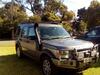
My truck in access height with the new tires.
Super helpful, thank you, and numbered bullets a great idea, I think this is where I'm at (as of this moment anyway).
1. No rods
2. No lifting of the struts
3. GAP tool = yes! Will this essentially replace the calibration that my tech would have done?
4. I'll probably ditch the spacers
5. I may keep my all season tires but I think I want some all terrain, 275/65/18 sound about right. Regarding 18" rims, what did your 18 OEMs come off of, and what's your opinion on the Terrafirma 18" steel rims?
Commentary: in listening to my tech and the feedback from the forums I feel I need to leave my faith in Land Rover; it seems they engineered the LR just as intended - just as they sold it. Each nuance has a relationship with the other. Save the suspension mods for the mall crawlers and use the money for accessories!
3 - Its not so much a replacement and simply a new calibration. The truck has no clue that its way higher than before. The sensors have variables which is why calibrations are done, to get the truck level. So a calibration to raise it, to the truck, is just another calibration. I recommend 1.5". You can exceed that, but then you start to affect handling a bit and you start to push the CV joints a little harder.
5 - OEM for me. I had stock 19" being an HSE and got a set of 18" from my neighbor since he had extras. I do want to get the steels from TerraFirma at some point, those look great.
Dakota's advice is spot on. I'd do all of that...in fact, that's already what I do!
275/65R18 tires on OEM 18s with a GAP tool and saved calibration setting that I select at the trailhead. Then in winter I have stock-sized Nokian tires on my 19s.
Dakota's advice is spot on. I'd do all of that...in fact, that's already what I do!
275/65R18 tires on OEM 18s with a GAP tool and saved calibration setting that I select at the trailhead. Then in winter I have stock-sized Nokian tires on my 19s.
The plan is coming together!
Buy GAP tool, have my tech re-calibrate the existing system and then me get started with the IID.
Get some 18s with 31 - 32” all terrains for the trail.
Keep my stock 19s with all seasons for winter (cannot access trails in winter, Colorado Rocky Mountains).
Oh, I will add that when getting larger tires you should ideally get XL load rated tires. The LR3 uses pressures that are higher than normal and most ATs cant properly handle that - in theory. Or you want h-rated sidewalls or better. I got e-rated Bridgestone Dueler Revo 3s in e-rated (LT). There have been instances where people got SL tires (standard load) and they failed under the additional tire PSI and weight of the truck. This does limit tire options but it keeps you in spec. And I am sure there are plenty that have gone SL with no issue. I just prefer not to gamble, plus I air down for off-road and in that instance I also need the better rated tires.




 LR3 Lift Help