When you click on links to various merchants on this site and make a purchase, this can result in this site earning a commission. Affiliate programs and affiliations include, but are not limited to, the eBay Partner Network.
Did the vehicle drop down on to the obstacle (aka gravity assisted impact damage) when causing the deformation or was it a case of a gentle bottoming out?
Regardless of whether or not the door can open, the slider looks like it did its job of keeping the rocker panel intact.
Did the vehicle drop down on to the obstacle (aka gravity assisted impact damage) when causing the deformation or was it a case of a gentle bottoming out?
Regardless of whether or not the door can open, the slider looks like it did its job of keeping the rocker panel intact.
No idea
So many slider impacts it was impossible to know.
From the damage, it looks like a lateral oblique impact with a rock with some force.
Yes the slider protected the sill/monocoque but I don't view sliders as sacrificial. Perhaps I am alone in this view. I think they should hold their shape as planned. This is essentially their one job.
I want something I can beat the hell out of of with my terrible driving skills and line selection abilities. I don't want a slider I have to baby.
*I don't intend to bash the product or the company. I think the sliders are good but it's always a tradeoff. Lighter weight, more box/step-like design, but with less strength. The merits of one over the other slider type is not for me to say. I wasn't driving so I can't speak to the exact how to and why.
Not trying to defend it, just looking at the silver lining.
Anything, no matter how well engineered, designed and built - has performance parameters that can be exceeded. Looks like you found the extent of that performance envelope.
Agree. I don't see slides as sacrificial items. I've seen a LOT of them take a beating. I haven't put my Lucky8/Rhino thru anything that would come close to that, but if they did ding that much I would expect to be in traction for a few weeks. In fact, I think I would shear the bolts off first. This isn't trying to start a slider war re: which are better - they are all GREAT. I just have never put hands on a Tuffant but expect them to rate the same as my L8/Rhino's. And that means I wouldn't have expected that either. The L8/Rhino's are essentially tubular. I wonder if there's a design difference that led to a blow RIGHT at a weak spot?? I'm interested to see how Tuffant replies. Honestly, I've not heard of any sliders taking a hit like that even from friends that off-road in other brands.
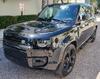
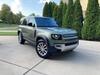
Maiden voyage, just warming up. Likely the last photo of this vehicle unmodded, the rock sliders have already arrived, 18" wheels are en route any moment now.
TR2 "Auto" mode was an interesting experience, Defenders that I drove before didn't have it. I wish it told me what exactly it's doing, and I wonder if it is available anywhere in the telemetry data stream.
Carpathian Grey didn't disappoint, blended in with dust just like I was hoping it would
Last edited by Vadiable Paradox; Apr 7, 2025 at 06:31 PM.
Maiden voyage, just warming up. Likely the last photo of this vehicle unmodded, the rock sliders have already arrived, 18" wheels are en route any moment now.
TR2 "Auto" mode was an interesting experience, Defenders that I drove before didn't have it. I wish it told me what exactly it's doing, and I wonder if it is available anywhere in the telemetry data stream.
Carpathian Grey didn't disappoint, blended in with dust just like I was hoping it would
TR2 is a really cool system, and it does work incredibly well. However, all of the instructors at the LR Experience Center at the Biltmore in Asheville, as well as the ones at the factory Experience Center in Solihull all told me that they prefer to select the most appropriate program to the terrain that you're driving over, as it already pre-loads the traction control, ABS, differentials, steering, throttle response, suspension etc. to what you're driving over, allowing for the most traction. TR2 is reactive, so it reads the terrain and adjusts accordingly. On average, it takes less than ten feet for the car to figure out what its driving over and to adjust accordingly. Really neat tech that works well, and definitely has its uses. I tend to use it mainly on the road as well as gravel and dirt roads, and sometimes snow.