


Wearables Coverage - Expected Life of Brake Pads & Rotors


Thread Starter
|
4th Gear
Joined: Mar 2021
Posts: 4
Likes: 0
From: Maryland's Eastern Shore
 Wearables Coverage - Expected Life of Brake Pads & Rotors
2021 Defender, P400, 22" wheels - Dealer told me that I can expect to need new brake pads and rotors within 15,000 miles, so I bought the coverage for 'wearables' for about $2,300 (sooner of 4 years or 60,000 miles). Platinum Plus plan covers, unlimited break pads,1 set of rotors, any belts and hoses, 1 wheel alignment, headlamp failure other than damage and 1 battery. I can still get a full refund for another 3 weeks.
Considering cancelling, but looking for advice on expected break/rotor wear and wheel alignment. Driving conditions: never off road, little traffic, likely 20,000 miles/year. A few local repair shops specialize in Euro cars, so dealer service for simple maintenance not a necessity.
Anyone have a more educated opinion about whether this coverage is likely worth it?
Considering cancelling, but looking for advice on expected break/rotor wear and wheel alignment. Driving conditions: never off road, little traffic, likely 20,000 miles/year. A few local repair shops specialize in Euro cars, so dealer service for simple maintenance not a necessity.
Anyone have a more educated opinion about whether this coverage is likely worth it?

Recovery Vehicle
Joined: May 2017
Posts: 1,135
Likes: 823
From: Boston, MA
I doubt you will need new hoses or belts before 100K miles, and headlights last that long as well. LR batteries seem to last exactly 4 years. I see you get unlimited pads but just 1 set of rotors so that is an issue as well. From my experience, every LR brake change required new pads AND new rotors. If you have torque vectoring, I can see where you may need new rear brakes by 15K miles. If not, you should be able to get at least 25K miles out of a set of brakes. Based on driving style, your results may vary.
IMHO, I'd just save the $2300 and apply it toward 2 sets of brakes.
IMHO, I'd just save the $2300 and apply it toward 2 sets of brakes.

Rock Crawling
Joined: Aug 2020
Posts: 314
Likes: 68
From: Ontario
Seems very expensive for coverage you're unlikely to use. Brakes are an easy DIY or relatively cheap indie fix with OEM parts and won't invalidate the warranty. 15K for rotors seems absurd but I have no idea what brake vectoring is or does to discs. Hoses should be fine. I echo the point on the battery. Personally I'd save the $ but have some ready to address any issues that creep in.

Recovery Vehicle
Joined: Mar 2020
Posts: 1,078
Likes: 713
High-end EU makers (MB, LR et. al.) do not generally allow in their specification their rotors to be turned. So any metal to metal contact or excessive heat shaping means $$$.
Torque vectoring will keep the nose from diving into a corner -- really nice to reduce pushing (awesome), but creates $$ on rear brakes; and it will turn sharper by differentially braking to the most unloaded wheel(s).
All depends on your driving. If you will be actively enjoying the P400 zoom zoom up and down the remote mountain roads -- the brake bills will come. Enjoy the driving regardless !!
I have a hard time contemplating what the V8 supercharged version with with the same features will demand in the brake replacement arena.
Torque vectoring will keep the nose from diving into a corner -- really nice to reduce pushing (awesome), but creates $$ on rear brakes; and it will turn sharper by differentially braking to the most unloaded wheel(s).
All depends on your driving. If you will be actively enjoying the P400 zoom zoom up and down the remote mountain roads -- the brake bills will come. Enjoy the driving regardless !!
I have a hard time contemplating what the V8 supercharged version with with the same features will demand in the brake replacement arena.
Thread Starter
|
4th Gear
Joined: Mar 2021
Posts: 4
Likes: 0
From: Maryland's Eastern Shore
Thanks to all for the great advice. I don't have the Electronic Active Differential which apparently adds torque vectoring.
I'm going to cancel the coverage and roll the $2,300 into Bitcoin!
I'm going to cancel the coverage and roll the $2,300 into Bitcoin!
Recovery Vehicle
Joined: Mar 2020
Posts: 1,078
Likes: 713
SKIP THIS IF DESIRED.
But, just for fun, I found this very concise description of potential non-open differentials to give a bit of a taste of the breadth of what is being offered on the market today. (Also, the effect of torque vectoring can be enhanced by braking (while decelerating).
https://www.matfoundrygroup.com/News..._How_They_Work
----------------------------------------------------------
In this cutaway, you can see the the pressure rings (also cut away) surrounding the core gears, which are forced apart by the central gear pins pushing against the angled surfaces under rotation. This movement pushes the pressure rings onto the clutch packs (yellow and blue) on either side, generating resistance and changing the behaviour of the axle from an open to a fixed type of effect.
Mechanical Clutch LSD’s are also further split into subtypes which behave in slightly different ways and alter when the pressure on the clutch plates and pressure rings is exerted:
In their basic operation the effect is smoother in application than mechanical LSDs, as the resistance builds in unison with the speed the wheels are travelling at in comparison to the differential case - providing a very gradual increase.
VLSDs are also able to direct torque more effectively to the wheel that has more traction. Because the fluid acts to be resistant under speed, if a wheel ever loses traction and spins the difference in speed between the two wheels inside the differential creates more resistance on the slower moving wheel - channelling more torque from the drive shaft to it.
VLSDs do become less effective with prolonged use, as the fluid heats it becomes less viscose and provides less resistance. It also cannot lock as fully as a mechanical LSD due to a fluid being unable to provide absolute resistance within an adequate space.
A disadvantage with both mechanical and viscous LSDs is that the system does not always channel torque effectively during high speed cornering, as it can interpret the faster moving outer wheel as losing traction. It then directs torque to inner wheel, generating over/understeer at the opposite moment to when it’s needed.
It achieves this by adding a layer of worm gearing to the traditional gear set up of an open differential. These sets of worm gears acting on each axle provide the resistance required to enable torque transfer, which it then achieves by having the worm gears in constant mesh with each other via connected spur gears.
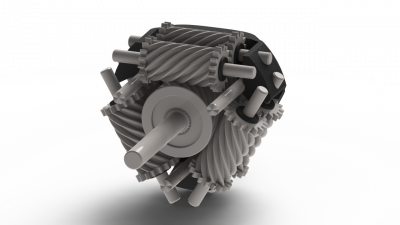
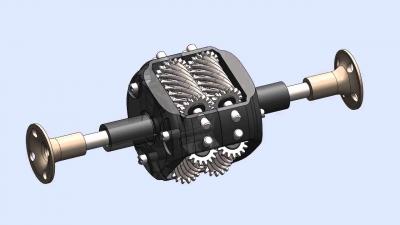
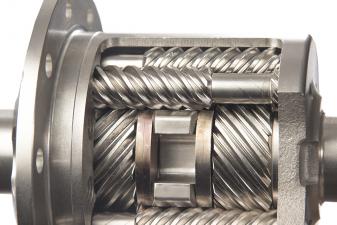 The first and second images show the three pairs of worm gears meshed with each half of the axle - with the spur gears at the end of each worm connecting the pairs. It's this connection that transfers torque from one wheel to the other, once one axle begins rotating faster than the other. While the first and second images are of the orginal torsen design, the third image is of the second version of the torsen differential. The newer design repositioned the worms gears to be inline with axles but still perform the same mechanical action. Each worm gear is still in contact with its pair, and only one side of the axle with spaces in the gear removing the mesh with the other side.
The constant mesh between the two sides of the differential has the added benefit of transferring the torque immediately, making it extremely responsive to changing road and driving conditions.
Whereas an open differential always has to split it’s torque split 50/50 between each wheel, the Torsen differential is capable of directing a greater percentage of torque through one wheel depending on the ratios of the gears. This removes the power limitation that open differentials suffer because the amount of torque available is not being limited by the amount traction in either wheel.
Furthermore, the gearing can also be machined in such a way as to impart a different ratio of resistance when accelerating and decelerating in the same way a one and half way limited slip differential does.
This all achieved mechanically without the use of electronics or any form of perishable part being sacrificed for friction, and overall the Torsen differential is the superior mechanical system that combines the primary benefits of all the previous differential types listed.
The active differential can use electronics to artificially alter the mechanical forces the system is experiencing through changing driving conditions. This makes them controllable and thus programmable, and by employing a range of sensors across the vehicle a computer can automatically detect which drive wheels to direct power to and when.
This drastically improves performance, especially over imperfect road surfaces, and is particularly favoured by rally drivers whose cars endure rapidly changing driving conditions and need a system that can keep up with their continuous adjustments to the vehicle.
By activating the opposite clutch to what a purely mechanically driven LSD would normally engage, you can use the effect to assist with steering while also putting more power down, overcoming the deficiencies in the LSD system.
On entry to the corner, a multi-way LSD exerts resistance to both wheels to at least partially lock the axle and stabilise it under braking - which is then released as the wheel speed drops and the vehicle turns in, allowing the wheels to rotate at different speeds .
However, instead of releasing the resistance on both wheels a TVD continues to activate the clutch on the outside wheel only - increasing the resistance experienced by that wheel and making the system channel more torque through it. This imbalance of power to the outside encourages the vehicle to turn into the corner sharper and reducing understeer.
By continuing to apply this resistance through the corner, as the vehicle passes the apex and begins to accelerate out it will continue to override a normal multiway-LSD - which would again interpret the faster moving outside wheel as slipping and divert torque during acceleration to the inside wheel, which it perceives as having more grip.
With the TVD exerting more resistance onto the outside wheels clutch, it tricks the system into diverting more torque through it - increasing the amount power that can be applied and reducing the understeer experienced under acceleration out of a corner.
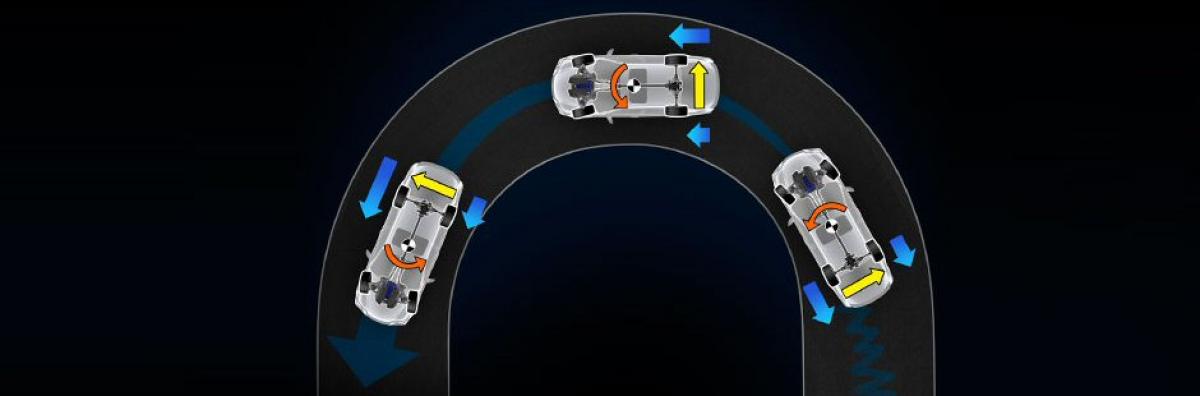 The yellow arrow highlights the torque transfer occuring through the corner, generated by the artifical resistance being exerted by the TVD on the outside wheel. This allows for greater acceleration out of the corner while the car's turning abilitty is increased.
A Torque Vectoring Differential is capable of channelling 100% of the available torque through a single wheel when needed in the most extreme of circumstances.
The downside to the system is it is very complicated and very expensive, and typically only used for racing/track applications for its high speed cornering potential.
Every system has it owns benefits and disadvantages, and although the more complicated systems are generally superior they have an attached cost that far exceeds the simpler systems.
As with everything automotive, how much benefit you will gain from each system comes to down to what exactly you will be doing with your vehicle and what you need your differential to be capable of. You’re not going to have much need for a Torque Vectoring Differential when visiting the local supermarket, unless you fancy yourself in the next WRC and can afford the fines - but you may want a Locking Differential if you happen to live in a rural location better accessed by an off-road vehicle.
But, just for fun, I found this very concise description of potential non-open differentials to give a bit of a taste of the breadth of what is being offered on the market today. (Also, the effect of torque vectoring can be enhanced by braking (while decelerating).
https://www.matfoundrygroup.com/News..._How_They_Work
----------------------------------------------------------
LIMITED SLIP DIFFERENTIAL:
LSD’s work to combine the benefits of Open and Locked differentials through a more complicated system. There are two categories which use different forms of resistance to achieve the same effect:MECHANICAL CLUTCH LSD:
This type of LSD surrounds the same core gearing seen in the open diff with a pair of pressure rings, which exert force on two sets of clutch plates positioned alongside the gears. This provides resistance to the independent rotation of the wheels changing the effect of the differential from open to locked – and providing it with the increased traction this type benefits from over an open differential.In this cutaway, you can see the the pressure rings (also cut away) surrounding the core gears, which are forced apart by the central gear pins pushing against the angled surfaces under rotation. This movement pushes the pressure rings onto the clutch packs (yellow and blue) on either side, generating resistance and changing the behaviour of the axle from an open to a fixed type of effect.
Mechanical Clutch LSD’s are also further split into subtypes which behave in slightly different ways and alter when the pressure on the clutch plates and pressure rings is exerted:
- In a one-way LSD, the pressure is only exerted under acceleration. This means that when cornering and off the power the diff behaves as an open type, allowing them to turn independently – but under acceleration the forced rotation of the differential creates friction in the clutch plates, locking them in place in order to gain more traction.
- A Two way LSD takes it a step further and exerts pressure on the clutch plates under deceleration too, in an effort to improve stability under braking on variable road surfaces.
- The one and half way again tries to combine the best of both subtypes, by exerting a greater amount of pressure under acceleration and lesser amount under deceleration.
VISCOUS LSD:
The second type of limited slip differential, they instead use a thick liquid in place of clutches to create the resistance needed to alter the differentials behaviour between open and locked. Due to having less moving parts than a mechanical LSD, VLSD’s are simpler but also have a wider range of advantages and disadvantages in comparison.In their basic operation the effect is smoother in application than mechanical LSDs, as the resistance builds in unison with the speed the wheels are travelling at in comparison to the differential case - providing a very gradual increase.
VLSDs are also able to direct torque more effectively to the wheel that has more traction. Because the fluid acts to be resistant under speed, if a wheel ever loses traction and spins the difference in speed between the two wheels inside the differential creates more resistance on the slower moving wheel - channelling more torque from the drive shaft to it.
VLSDs do become less effective with prolonged use, as the fluid heats it becomes less viscose and provides less resistance. It also cannot lock as fully as a mechanical LSD due to a fluid being unable to provide absolute resistance within an adequate space.
A disadvantage with both mechanical and viscous LSDs is that the system does not always channel torque effectively during high speed cornering, as it can interpret the faster moving outer wheel as losing traction. It then directs torque to inner wheel, generating over/understeer at the opposite moment to when it’s needed.
TORSEN DIFFERENTIAL:
The Torsen (Torque – Sensing) differential employs the use of some clever gearing to produce the same effect as a limited Slip Differential without the need for clutches or fluid resistance.It achieves this by adding a layer of worm gearing to the traditional gear set up of an open differential. These sets of worm gears acting on each axle provide the resistance required to enable torque transfer, which it then achieves by having the worm gears in constant mesh with each other via connected spur gears.
The first and second images show the three pairs of worm gears meshed with each half of the axle - with the spur gears at the end of each worm connecting the pairs. It's this connection that transfers torque from one wheel to the other, once one axle begins rotating faster than the other. While the first and second images are of the orginal torsen design, the third image is of the second version of the torsen differential. The newer design repositioned the worms gears to be inline with axles but still perform the same mechanical action. Each worm gear is still in contact with its pair, and only one side of the axle with spaces in the gear removing the mesh with the other side. The constant mesh between the two sides of the differential has the added benefit of transferring the torque immediately, making it extremely responsive to changing road and driving conditions.
Whereas an open differential always has to split it’s torque split 50/50 between each wheel, the Torsen differential is capable of directing a greater percentage of torque through one wheel depending on the ratios of the gears. This removes the power limitation that open differentials suffer because the amount of torque available is not being limited by the amount traction in either wheel.
Furthermore, the gearing can also be machined in such a way as to impart a different ratio of resistance when accelerating and decelerating in the same way a one and half way limited slip differential does.
This all achieved mechanically without the use of electronics or any form of perishable part being sacrificed for friction, and overall the Torsen differential is the superior mechanical system that combines the primary benefits of all the previous differential types listed.
ACTIVE DIFFERENTIAL:
Very similar to a limited slip differential, the active differential still employs mechanisms to provide the resistance needed to transfer torque from one side to another - but rather than relying on purely mechanical force, these clutches can be electronically activated.The active differential can use electronics to artificially alter the mechanical forces the system is experiencing through changing driving conditions. This makes them controllable and thus programmable, and by employing a range of sensors across the vehicle a computer can automatically detect which drive wheels to direct power to and when.
This drastically improves performance, especially over imperfect road surfaces, and is particularly favoured by rally drivers whose cars endure rapidly changing driving conditions and need a system that can keep up with their continuous adjustments to the vehicle.
TORQUE VECTORING DIFFERENTIAL:
The TVD takes this electronically enhanced system even further by using it to manipulate the angle, or vector, of the vehicle in and out of the turns by encouraging specific wheels to receive more torque at key moments - improving cornering performance.By activating the opposite clutch to what a purely mechanically driven LSD would normally engage, you can use the effect to assist with steering while also putting more power down, overcoming the deficiencies in the LSD system.
On entry to the corner, a multi-way LSD exerts resistance to both wheels to at least partially lock the axle and stabilise it under braking - which is then released as the wheel speed drops and the vehicle turns in, allowing the wheels to rotate at different speeds .
However, instead of releasing the resistance on both wheels a TVD continues to activate the clutch on the outside wheel only - increasing the resistance experienced by that wheel and making the system channel more torque through it. This imbalance of power to the outside encourages the vehicle to turn into the corner sharper and reducing understeer.
By continuing to apply this resistance through the corner, as the vehicle passes the apex and begins to accelerate out it will continue to override a normal multiway-LSD - which would again interpret the faster moving outside wheel as slipping and divert torque during acceleration to the inside wheel, which it perceives as having more grip.
With the TVD exerting more resistance onto the outside wheels clutch, it tricks the system into diverting more torque through it - increasing the amount power that can be applied and reducing the understeer experienced under acceleration out of a corner.
The yellow arrow highlights the torque transfer occuring through the corner, generated by the artifical resistance being exerted by the TVD on the outside wheel. This allows for greater acceleration out of the corner while the car's turning abilitty is increased.A Torque Vectoring Differential is capable of channelling 100% of the available torque through a single wheel when needed in the most extreme of circumstances.
The downside to the system is it is very complicated and very expensive, and typically only used for racing/track applications for its high speed cornering potential.
Every system has it owns benefits and disadvantages, and although the more complicated systems are generally superior they have an attached cost that far exceeds the simpler systems.
As with everything automotive, how much benefit you will gain from each system comes to down to what exactly you will be doing with your vehicle and what you need your differential to be capable of. You’re not going to have much need for a Torque Vectoring Differential when visiting the local supermarket, unless you fancy yourself in the next WRC and can afford the fines - but you may want a Locking Differential if you happen to live in a rural location better accessed by an off-road vehicle.


Three Wheeling
Joined: Jan 2021
Posts: 54
Likes: 26
Warranty includes unlimited pads but only one set of rotors. I believe Land Rover requires new rotors with every pad change. I realize this sounds crazy but that is a requirement on my Sport. You should confirm with the dealer service manager.

Recovery Vehicle
Joined: Mar 2020
Posts: 1,078
Likes: 713
I just confirmed on the configurator in the U.S. that one apparently does not need to upgrade to either the towing package or any of these to gain the benefit of the electronic rear differential:
Advanced Off-Road Capability Pack:
Having driven off-road daily for the past few months, I have concluded:
1) that ATPC is really not necessary, except in very arduous and unique situations. It does something remarkable, which is control the throttle totally automatically from a dead start, and automatically feed power to each wheel independently in an attempt to avoid wheel all spin. I think it is useful in sand, particularly -- and with recovery boards -- which are not warranted to accept wheel spin. Plus, it is really gentle on trails.
2) Terrain response 2 has the very useful day-to-day feature of Auto mode, which is where I leave my setting 95% of the time. I do not think TR1 has Auto mode (but am not sure -- it doesn't on the LR4.)
3) I have purposefully not yet investigated how much configurability is available in configurable terrain response, as I wanted to get used to the other features and computer logic to understand the incremental improvement on the LR4, which is where I gained active insight on TR1. I assume Defender TR1 is the same or very similar to TR on the LR4.
I think I have identified areas of the non-configurable approach to begin to experiment with the configurable capability.
Overall, my thought is that the content of the Advanced Off-road capability pack is overkill for anyone who is either not off-road daily, not doing serious overlanding, or who prefers to not pay $$ to fiddle with the configurable nature of the Defender's off-road electronics. I have it and have none of the other electronic fiddle options, because the 4WD has value to me, while the communication electronics do not.
For perspective, I am still not over losing the CD player, and have not yet tackled appleplay (or what ever it is called) ... but I do now have an iphone --- so I'm trying to get there!
Hopefully, others with experience with the New Defender off-road will also comment.
Advanced Off-Road Capability Pack:
- Terrain Response 2
- Configurable Terrain Response
- All Terrain Progress Control (ATPC)
Having driven off-road daily for the past few months, I have concluded:
1) that ATPC is really not necessary, except in very arduous and unique situations. It does something remarkable, which is control the throttle totally automatically from a dead start, and automatically feed power to each wheel independently in an attempt to avoid wheel all spin. I think it is useful in sand, particularly -- and with recovery boards -- which are not warranted to accept wheel spin. Plus, it is really gentle on trails.
2) Terrain response 2 has the very useful day-to-day feature of Auto mode, which is where I leave my setting 95% of the time. I do not think TR1 has Auto mode (but am not sure -- it doesn't on the LR4.)
3) I have purposefully not yet investigated how much configurability is available in configurable terrain response, as I wanted to get used to the other features and computer logic to understand the incremental improvement on the LR4, which is where I gained active insight on TR1. I assume Defender TR1 is the same or very similar to TR on the LR4.
I think I have identified areas of the non-configurable approach to begin to experiment with the configurable capability.
Overall, my thought is that the content of the Advanced Off-road capability pack is overkill for anyone who is either not off-road daily, not doing serious overlanding, or who prefers to not pay $$ to fiddle with the configurable nature of the Defender's off-road electronics. I have it and have none of the other electronic fiddle options, because the 4WD has value to me, while the communication electronics do not.
For perspective, I am still not over losing the CD player, and have not yet tackled appleplay (or what ever it is called) ... but I do now have an iphone --- so I'm trying to get there!
Hopefully, others with experience with the New Defender off-road will also comment.
Last edited by TrioLRowner; Mar 13, 2021 at 10:50 AM.
Recovery Vehicle
Joined: Feb 2010
Posts: 1,057
Likes: 23
From: Boston
has anyone actually seen a brake job done on a new defender without Land Rover sw? I know in mass they have to make that sw available to Indy shops now. Thank god for the right to repair bill. But I’d be surprised (pleasantly) if brakes and rotors were something that was simple in the driveway anymore with all the wizardry in these cars.

