When you click on links to various merchants on this site and make a purchase, this can result in this site earning a commission. Affiliate programs and affiliations include, but are not limited to, the eBay Partner Network.
D1 99 over weird heating - park brake on, temp rises, brake off it drops?!?!
Hello,
I recently did a coolant flush, replaced the entire cooling system (all the hoses, t-stat, gasket, water pump, etc.), and still have this weird overheating issue that I can’t trace.
I am guessing there is still air or crap in the system.
I did the 30 minute bleed twice with the passenger front tire on a raised surface and let the system idle with the heater on until the air bubbles came out of the rad cap as well as the reservoir cap off... after 30 or so minutes I saw no more bubbles and it was overflowing. I have done this twice now.
Now, when I put the AC on the system overheats like crazy... I checked my ac fans, and the viscous fan and all of the fans work without issue.
Could I be looking at a faulty thermostat at this point?
One weird thing, when I pull over and put the e-brake on, the temp drops on the dash cluster. When I put the e-brake off, the temps jump.
I have out of ideas and am frustrated beyond belief.
Thanks for the help
Last edited by archaeology_student; Jul 5, 2021 at 05:42 PM.
I recently did a coolant flush, replaced the entire cooling system (all the hoses, t-stat, gasket, water pump, etc.), and still have this weird overheating issue that I can’t trace.
I am guessing there is still air or crap in the system.
I did the 30 minute bleed twice with the passenger front tire on a raised surface and let the system idle with the heater on until the air bubbles came out of the rad cap as well as the reservoir cap off... after 30 or so minutes I saw no more bubbles and it was overflowing. I have done this twice now.
Now, when I put the AC on the system overheats like crazy... I checked my ac fans, and the viscous fan and all of the fans work without issue.
Could I be looking at a faulty thermostat at this point?
One weird thing, when I pull over and put the e-brake on, the temp drops on the dash cluster. When I put the e-brake off, the temps jump.
I have out of ideas and am frustrated beyond belief.
Thanks for the help
How do you know that it's overheating as opposed to something like a bad ground to the temperature gauge? Do you have a real time obd2 reader that is telling you that the truck is overheating ?
there are two temperature senders on the engine, one goes to the ecu, the other to the gauge. The one to the gauge could be faulty/losing its ground.
I'd check the battery ground cable. It connects in 2 places, the post right behind the battery on the inner fender and the frame just forward of the passenger tire. Then make sure the ground strap from the frame rail right behind the passenger tire to the engine block is present.
Also, next time it says its overheating remove the brake master cylinder cap to trigger the brake light and see if that changes anything. This will tell you if its the brake cable acting as a ground path or if there is something going on with the ground path of the gauge cluster itself and the brake light is too much current for wherever the high resistance connection is.
X2 for the OBD reader. You also could use a hand held infrared thermometer or even a thermocouple thermometer to measure at the T-stat housing (close to the gauge and ECU temp sensors). With the interaction with other electrical devices, it sounds more likely an electrical circuit problem. Actual engine temperature does not "jump" up or down, due to physics or thermodynamics (take your pick). I ran a thermocouple to the T-stat housing on my '94 so I can read the temp while sitting inside (no OBD port on the '94).
On my '96 though, I did find the OBD ECT reading bounced up and down when I was on rough road surfaces. I tracked that down to a loose connection or some corrosion on the ground splice for the ECU temperature sensor. The splice is inside the wiring bundle across the front of the block. It affected several other sensors in that general area as well, so I cleaned up the wires and soldered them together for a solid electrical connection. Now the ECT signal is solid too.
For the two temp sensors, a bad ground connection creates higher resistance in the circuit, which shows up as Lower temperature. If the signal side is getting shorted to ground somehow, that would show as high temperature on the dash gauge or at the ECU (OBD reader).
If your new T-stat has the hole on top with the jiggle valve, then any air will eventually work itself out, but the hole does need to be at 12 o'clock. Hope this helps.
Last edited by JohnZo; Jul 7, 2021 at 01:01 AM.
Reason: More information
A couple of more things to stay on top of. When Dexcool and green antifreeze are mixed, it scales over time producing a white chalk that eventually settles in the radiator tank and the bottom of the water jackets in the block. My single pin gauge sensor is 515ohms at 80degrees ambient temp. Monitor the coolant level until it stabilizes. Also , a good aftermarket mechanical temp gauge is a plus. There is plenty of room on the lower intake to drill and tap for a probe.Hope this sheds more light, and if I am speaking out of school, I apologize in advance.
For the two temp sensors, a bad ground connection creates higher resistance in the circuit, which shows up as Lower temperature. If the signal side is getting shorted to ground somehow, that would show as high temperature on the dash gauge or at the ECU (OBD reader).
True with a bad ground on the sending unit, but since that ground is the engine block it's very unlikely to ever be the problem.
The case here is a bad ground from the gauge cluster. The gauge is a balanced coil that shows an almost static value until the voltage after the first coil is higher than the zener diode rating when compared to the voltage after the R1 resistor.
An increase in ground resistance will cause the voltage at that point to be higher and bypass current from the opposing gauge coil, causing the needle to move. The OBD2 port should still report a more correct temperature regardless of the chassis ground problem.
Connecting my obd2 device and using torque on android I saw real-time temps creep up to 99° Celsius /210° Fahrenheit
At this point I am narrowing it down to either a brand new faulty thermostat (it’s the one with the plastic bobble to release air) or air still being trapped in the system.
X2 for the OBD reader. You also could use a hand held infrared thermometer or even a thermocouple thermometer to measure at the T-stat housing (close to the gauge and ECU temp sensors). With the interaction with other electrical devices, it sounds more likely an electrical circuit problem. Actual engine temperature does not "jump" up or down, due to physics or thermodynamics (take your pick). I ran a thermocouple to the T-stat housing on my '94 so I can read the temp while sitting inside (no OBD port on the '94).
On my '96 though, I did find the OBD ECT reading bounced up and down when I was on rough road surfaces. I tracked that down to a loose connection or some corrosion on the ground splice for the ECU temperature sensor. The splice is inside the wiring bundle across the front of the block. It affected several other sensors in that general area as well, so I cleaned up the wires and soldered them together for a solid electrical connection. Now the ECT signal is solid too.
For the two temp sensors, a bad ground connection creates higher resistance in the circuit, which shows up as Lower temperature. If the signal side is getting shorted to ground somehow, that would show as high temperature on the dash gauge or at the ECU (OBD reader).
If your new T-stat has the hole on top with the jiggle valve, then any air will eventually work itself out, but the hole does need to be at 12 o'clock. Hope this helps.
oh, I made sure the hole was in the 12 o’clock position and double checked
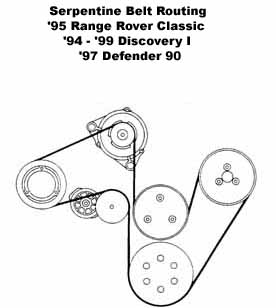
One more thing to check....make sure the belt is routed correctly (diagram below). I went through a similar process and the only thing that fixed my overheating issue was a new radiator. I had already replaced the hoses, water pump, thermostat (even ran it without one and it didn't help), flushed the radiator 3 times with various cleaning products, made sure to burp the system each time, and after all that it would still overheat. I installed a new radiator and it was, and still is, like a completely different vehicle. Even in near 100 degree temps, old Indy usually hovers around the high 170-low 180 range at highway speeds. It sometimes creeps into the low 190's at long traffic lights, but when the fan starts roaring during acceleration, it drops quickly back to it's new normal operating temp.




 D1 99 over weird heating - park brake on, temp rises, brake off it drops?!?!