


How to change Crankshaft position sensor 2000 DII


Thread Starter
|
Mudding
Joined: Apr 2007
Posts: 178
Likes: 4
From: NJ
 How to change Crankshaft position sensor 2000 DII
Crankshaft position and speed sensor (CPS) is one of many electronic sensors used by the
ECM (engine computer management) to run the engine. As it name implies, it sends signal to the ECM to determine the position of the crankshaft, its angular velocity. This in turn is processed by the ECM to aid in ignition timing and fuel injection timing. Malfunction of this sensor alone can shutdown your engine quickly like a switch.
Pure CPS failure will most likely not cause any SERVICE ENGINE SOON or MIL fault to light up. One of the signs of imminent CPS failure is a perfectly running engine that just stalled.
It may be subsequently restarted but be forewarned, it can stop at anytime FOR GOOD unless replaced.
My personal experience was after the truck was restarted after my initial stall, the truck was able to be driven another 2 miles to its destination. After shutdown, the engine would not start. The starter would crank but there would be NO IGNITION.
Things to check first.
Inertia switch on firewall was not activated.
2 fuses inside the driver side not blown.
No spark. I use an induction timing light to determine if there was spark of not.
TOOL:
7 mm wrench or 7 mm socket
8 mm wrench or 8 mm socket
Always make sure the the truck is up on jack stands before crawling under.
Use proper chocks.
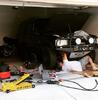
Approach to the CPS is best done from under the truck.
It is located on the rear part of the engine block below cylinder 7. See pic 365.jpg
The cover is secured by 7mm bolts. Using a socket ratchet combo will speed up removal of bolt versus wrench.
Once the cover is removed, the CPS is secured by 2 nuts ( 8mm ) and a collar/spacer. See pic 368.jpg.
The connector also has to be removed from slot securing it to the engine block. Once removed it may be separated from the rest of the engine harness.
Replacement is the reverse of installation.
Nuts are torqued to 5 lb/ft.
Don't forget the spacers.
Careful not to introduce foreign metallic objects into the block since the tip of the CPS is magnetic and can pick up extra nuts and .... you know the rest.
About 60 min. for entire job.
Ed
ECM (engine computer management) to run the engine. As it name implies, it sends signal to the ECM to determine the position of the crankshaft, its angular velocity. This in turn is processed by the ECM to aid in ignition timing and fuel injection timing. Malfunction of this sensor alone can shutdown your engine quickly like a switch.
Pure CPS failure will most likely not cause any SERVICE ENGINE SOON or MIL fault to light up. One of the signs of imminent CPS failure is a perfectly running engine that just stalled.
It may be subsequently restarted but be forewarned, it can stop at anytime FOR GOOD unless replaced.
My personal experience was after the truck was restarted after my initial stall, the truck was able to be driven another 2 miles to its destination. After shutdown, the engine would not start. The starter would crank but there would be NO IGNITION.
Things to check first.
Inertia switch on firewall was not activated.
2 fuses inside the driver side not blown.
No spark. I use an induction timing light to determine if there was spark of not.
TOOL:
7 mm wrench or 7 mm socket
8 mm wrench or 8 mm socket
Always make sure the the truck is up on jack stands before crawling under.
Use proper chocks.
Approach to the CPS is best done from under the truck.
It is located on the rear part of the engine block below cylinder 7. See pic 365.jpg
The cover is secured by 7mm bolts. Using a socket ratchet combo will speed up removal of bolt versus wrench.
Once the cover is removed, the CPS is secured by 2 nuts ( 8mm ) and a collar/spacer. See pic 368.jpg.
The connector also has to be removed from slot securing it to the engine block. Once removed it may be separated from the rest of the engine harness.
Replacement is the reverse of installation.
Nuts are torqued to 5 lb/ft.
Don't forget the spacers.
Careful not to introduce foreign metallic objects into the block since the tip of the CPS is magnetic and can pick up extra nuts and .... you know the rest.
About 60 min. for entire job.
Ed
Last edited by EVN137; Oct 6, 2009 at 12:50 PM.




Rock Crawling
Joined: Oct 2009
Posts: 447
Likes: 0
From: St Pete FL USA
I gather the D2 uses a Bosch ECU, and having had to fight this battle on the 87 BMW 635 I'm replacing with my new Landy, I would speculate the reason is the same: if the ECU doesn't see a CPS pulse, *it shuts off the fuel pump*.


2nd Gear
Joined: Feb 2010
Posts: 2
Likes: 0
 Followup on CPS replacement
Just wanted to update on the CPS job. Took me a little longer than 60 mins because of difficulty getting connector removed from harness wiring due to tight space. But was able to remove with a little ingenuity and patience. Rover started right up and sounded like a charm. Thanks again for your tutorial. No more pushing for alternate side parking for me. Thanks again.


2nd Gear
Joined: Apr 2010
Posts: 2
Likes: 0
Where do the spacers go while installing a new CPS sensor? When i pulled the bolts out the spacers just fell on the ground. Between the block and the sensor? between the metal and plastic part of the sensor? towards the head of the bolt? any help would be greatly appreciated.