


Poor Mans 8$ CAI... Another Crappy How To


Super Moderator
Joined: Jan 2011
Posts: 16,322
Likes: 88
From: Savannah Georgia

As for the underhood temps, Spike in his last post detailed testing with a separate thermal sensor and meter, never found over 150F as I recall. Perhaps something to look at.
I was wondering about the effects of the dead end parts of the head on cooling. As you have water channels on both ends, but the rear set is blocked off by the intake. So there is a space inside the head, with a dead end passage, and hot water "lingers" there.
Not sure how much heat transfer you could have from the TB heater, a number of people run without it and I don't recall posts about better MPG, performance, etc. Perhaps one method might be a bypass valve, so you could keep it switched off until frozen area driving.
Of course, the Buick 215 engine was the in first producation car in the US with factory turbo, 1962 F-85 "Jetfire".
I was wondering about the effects of the dead end parts of the head on cooling. As you have water channels on both ends, but the rear set is blocked off by the intake. So there is a space inside the head, with a dead end passage, and hot water "lingers" there.
Not sure how much heat transfer you could have from the TB heater, a number of people run without it and I don't recall posts about better MPG, performance, etc. Perhaps one method might be a bypass valve, so you could keep it switched off until frozen area driving.
Of course, the Buick 215 engine was the in first producation car in the US with factory turbo, 1962 F-85 "Jetfire".

Recovery Vehicle
Joined: Jun 2012
Posts: 1,080
Likes: 57
From: Queens, NYC
Holy necropost...
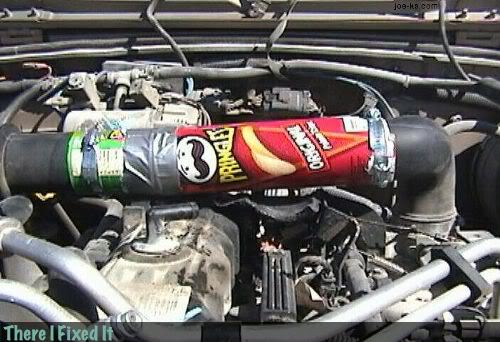
CAI's are great for cooling the intake charge, which in turn can lower engine operating temps a scosche and improve performance in even more instances, but the CAI outlined in this tutorial...
This is a hydrolocked engine waiting to happen in the best case scenario, and a rod or two vacating the block in the worst case. I wouldn't follow suit, personally.
CAI's are great for cooling the intake charge, which in turn can lower engine operating temps a scosche and improve performance in even more instances, but the CAI outlined in this tutorial...
This is a hydrolocked engine waiting to happen in the best case scenario, and a rod or two vacating the block in the worst case. I wouldn't follow suit, personally.



Mudding
Joined: Jun 2013
Posts: 135
Likes: 1
From: New York/New Jersey/Phila, PA
You're too nice; ya gotta raise the rent, or the squirrels won't leave  . I get chipmunks. Some people leave moth ***** scattered around or use repellant spray, like for trash. Gotta be careful it's not flammable, though. Others use more "permanent" methods...traps/poison/target practice
  .
.
I often just park the cars further away and hope the squirrels/chipmunks find another car that they prefer to mine. It's not very neighborly, but sometimes works...
. I get chipmunks. Some people leave moth ***** scattered around or use repellant spray, like for trash. Gotta be careful it's not flammable, though. Others use more "permanent" methods...traps/poison/target practice . I often just park the cars further away and hope the squirrels/chipmunks find another car that they prefer to mine. It's not very neighborly, but sometimes works...

Recovery Vehicle
Joined: Sep 2012
Posts: 1,169
Likes: 52
From: Tampa, FL
I wish the OP would come back and give us an update.
I'd be curious if he's still running the CAI and if it affected his gas mileage.
It DOES seem like a CAI is a good idea. These trucks seem to get pretty damn hot under the hood, even when they aren't overheating and melting the aluminum block.
I'd be curious if he's still running the CAI and if it affected his gas mileage.
It DOES seem like a CAI is a good idea. These trucks seem to get pretty damn hot under the hood, even when they aren't overheating and melting the aluminum block.

Recovery Vehicle
Joined: Feb 2011
Posts: 1,027
Likes: 1
From: Wabash
snorkle and be done with it haha... or put a cone filter where the box was, and seal off aroudn it so its forced to pull air from the circular hole where he has the ducting tube running down through lol.... tinfoil wrapped cardboard or plywood with split vac hose around the edges does fine lol
Mudding
Joined: Jun 2013
Posts: 135
Likes: 1
From: New York/New Jersey/Phila, PA
After all the jokes abt his close to the road "experiment", Spencer did post that if he had $500 for a snorkel, he would...
I like Bundu's solution: Get duct tape, pop a vent, and run 8' of that flexible dryer vent hose up to the roof. Then, it's be a poor man's snorkel.
I like Bundu's solution: Get duct tape, pop a vent, and run 8' of that flexible dryer vent hose up to the roof. Then, it's be a poor man's snorkel.

Rock Crawling
Joined: Aug 2012
Posts: 471
Likes: 8
From: Tulsa, OK

