When you click on links to various merchants on this site and make a purchase, this can result in this site earning a commission. Affiliate programs and affiliations include, but are not limited to, the eBay Partner Network.
Hi, Thought I would introduce myself since I am sure I will have many questions for this group. I recently purchased a 1970 Santana 88. I have owned and restored many European Cars, mostly Porsche and Jaguar, but this is my first Land Rover. I have very little information on its history other than the person I bought it from purchased it in Bogota Columbia, had it ¨restored¨ there and imported it to the US.
I am still going through it and learning about Land Rovers in general.
The Good: -Starts, runs, and drives -Chassis seems to be in good shape and mostly rust free -looks good from 10´ away
The not so good: -Brakes are almost non-existent and the brake lights do not function (I am currently in the process of replacing the brakes all around) -According to the workshop manual there are 29 places that could leak. Luckily I think I only have leaks from about 25 of them, haha -Coolant is brown (rusty) but doesn't show signs of oil intrusion. It´s clearing up after a few flushes -Bogs and sometimes dies when I first hit the throttle, but only when the cold start is off. When pulled on there it is very smooth and responsive. -Looks like it has a Weber carb and has an alternator added. -There is no hose connected to the vacuum advance on the distributor. Not sure if it´s required or where it should connect -There is much much more but this is most of what I have gone through so far
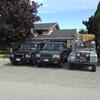
Here are a few pics. Let me know if you see anything interesting or problematic in them. I will save my questions, if I can find them in the search, for separate posts
If the brakes are like my 2A, they are very difficult to bleed using the normal method. What I found to be very successful was to pressurize the top of the reservoir with maybe 5 psi of air. I did this by turning my air compressor regulator down, then using an air blaster with a rubber hose at the tip, putting the air blaster on the vent hole at the top of the reservoir. I loosened a bleeder fitting one wheel at a time, with a hose to a container to catch the fluid, then pressurized the reservoir for 10-20 seconds, making sure not to empty the reservoir.



 New to me 1970 Santana 88