


dual battery install pictures?


Rock Crawling
Joined: Sep 2011
Posts: 280
Likes: 1

For anyone who is interested, here is a good primer about making our own battery cables.
Making Your Own Battery Cables Photo Gallery by Compass Marine at pbase.com
This article is geared towards Marine use, but the basic ideas apply. Anything that you do that is "Marine Grade" on your car will be TWICE as good than the automotive equivalent. I found this guy's blog last spring and I spent the entire summer, off-and-on, re-doing a lot of the wiring on my boat.
Here is another article about terminating wires. Probably a good primer for those who are adding a lot of accessories.
Marine Wire Termination Photo Gallery by Compass Marine at pbase.com
Making Your Own Battery Cables Photo Gallery by Compass Marine at pbase.com
This article is geared towards Marine use, but the basic ideas apply. Anything that you do that is "Marine Grade" on your car will be TWICE as good than the automotive equivalent. I found this guy's blog last spring and I spent the entire summer, off-and-on, re-doing a lot of the wiring on my boat.
Here is another article about terminating wires. Probably a good primer for those who are adding a lot of accessories.
Marine Wire Termination Photo Gallery by Compass Marine at pbase.com

Baja
Joined: Sep 2007
Posts: 5,232
Likes: 52
From: Georgia, USA
If you use good adhesive lined heat shrink and don't use open barrel lugs I've not seen any evidence that the tinned conductor wiring is really needed. There's certainly nothing wrong with using it if you want to pay the extra price.
I've cut open 10 year old crimps I've made that were exposed to the elements under the car and the conductors look as bright as they day I made attached the lug.
I've cut open 10 year old crimps I've made that were exposed to the elements under the car and the conductors look as bright as they day I made attached the lug.

Thread Starter
|
Winching
Joined: Aug 2011
Posts: 600
Likes: 1
From: northwest
my primary motivation for dual batteries is for the purposes of camping and running things off of that second battery with the truck off. it seems i could really go wild with running small draw accessories if i knew that i could run one deep cycle completely flat, then charge the next day with running the truck...
thanks for all that info guys!
thanks for all that info guys!


Super Moderator
Joined: Jan 2011
Posts: 16,322
Likes: 88
From: Savannah Georgia
Marine stuff worth a look, lots of boats set up with dual batts and switch, run on A, B, or both, etc. Boat guys have this thing about batteries, starting, paddling back from ten miles out, and having enough juice to call the Coast Guard or Sea Tow on the VHF.
Thread Starter
|
Winching
Joined: Aug 2011
Posts: 600
Likes: 1
From: northwest
i think thats the plan... i see no need to shell out a couple hundred $ to painless or whoever just so i can get a marine solenoid and $2 worth of wire/zip ties/connectors.
Rock Crawling
Joined: Sep 2011
Posts: 280
Likes: 1
Those AB switches can be had for as little as $30. I have one in my garage I am probably not ever going to use again. Buzz is right.... There is a HUGE difference when your battery goes dead 25 miles out to sea vs. a Walmart parking lot 
You don't have to go marine grade... It was just a suggestion. If you go off-road or expedition, it may be worth the few extra bucks just for the insurance. There is a reason why "Marine Grade" cost more. The tinned copper only really protects you agains salt water.
Another cheap way to do it.... And this is how I did it on my boat until I picked up an isolator. Just throw a deep cycle battery in your "extra" battery cage and hook up your inverter (proper guage wiring of course) and just run what you want off of it. You would be surprised how much juice you can squeeze out of a deep cycle battery... They are designed for long slow discharges. When you get home, you just plug in the trickle charger and top it off. Alternatively, if you are in the field, you can hook up jumper cables and top it off.
You don't have to go marine grade... It was just a suggestion. If you go off-road or expedition, it may be worth the few extra bucks just for the insurance. There is a reason why "Marine Grade" cost more. The tinned copper only really protects you agains salt water.
Another cheap way to do it.... And this is how I did it on my boat until I picked up an isolator. Just throw a deep cycle battery in your "extra" battery cage and hook up your inverter (proper guage wiring of course) and just run what you want off of it. You would be surprised how much juice you can squeeze out of a deep cycle battery... They are designed for long slow discharges. When you get home, you just plug in the trickle charger and top it off. Alternatively, if you are in the field, you can hook up jumper cables and top it off.

Rock Crawling
Joined: Oct 2012
Posts: 407
Likes: 0
From: San Diego, CA
Resurrecting another dead thread. I've looked through the search about adding a second battery to my D1 and found the usual "remove the air box" and "relocate the power steering reservoir" recommendations. None of those seem to help, especially since my Safari snorkel kicks the airbox inboard taking away potential space for my PS reservoir. Even if I could extend the bracket I'd not be able to lock/open the air box top. Looking at suitable batteries (Optima yellow, Sears DieHard), they're all just over 9" wide not giving me much room to work with. Any suggestions, or am I relegated to a remote battery mount in the cab?
Reason for dual batteries is I hope to add a winch and various accessories, and will be Rovering alone.
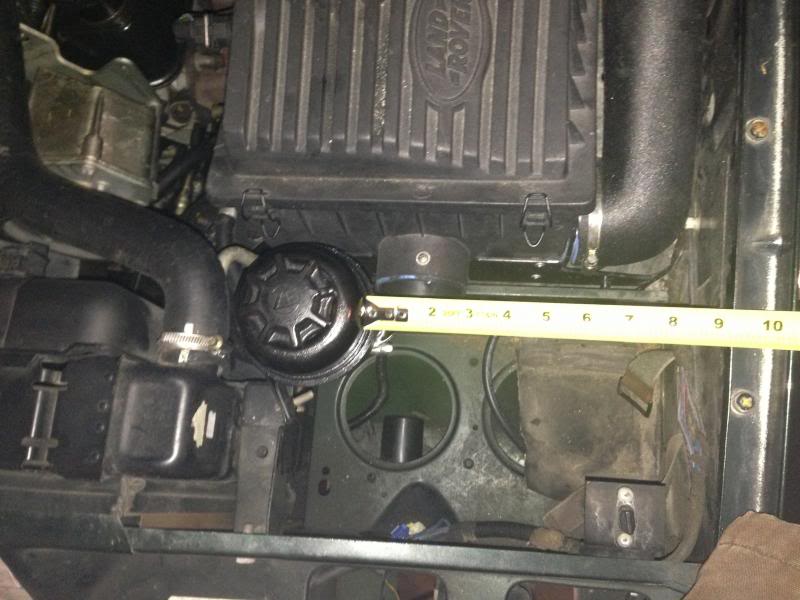
Reason for dual batteries is I hope to add a winch and various accessories, and will be Rovering alone.


