


Air Intake Temps


 Air Intake Temps
I've noticed that my air intake temps are usually about 10 - 15 degrees hotter than the outside air. It was in the 90's today and for the most part it was reading 110º
I was in a drive through with a line that was taking for EVER. I watched as the temp kept rising and rising. Up to 160º!!
WTF? I haven't seen my coolant temp in the 200's since my switch to a 180 thermostat. All of the temps cooled back down once I was moving again, but why did the intake temp get so damn hot? Do I really need a snorkel just to keep cooler air going into my engine?
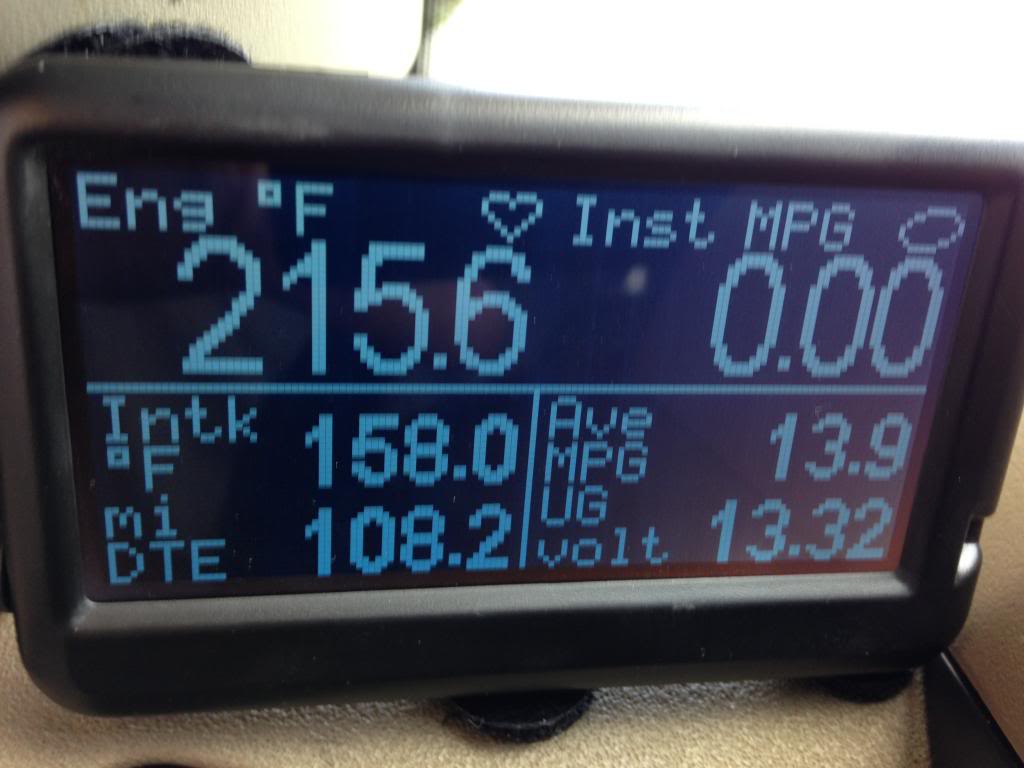
I was in a drive through with a line that was taking for EVER. I watched as the temp kept rising and rising. Up to 160º!!
WTF? I haven't seen my coolant temp in the 200's since my switch to a 180 thermostat. All of the temps cooled back down once I was moving again, but why did the intake temp get so damn hot? Do I really need a snorkel just to keep cooler air going into my engine?

Recovery Vehicle
Joined: Sep 2012
Posts: 1,169
Likes: 52
From: Tampa, FL
It does get way too hot under these hoods. I actually wonder if a vent at the back of the hood might not be a bad idea to help cool the engine when stopped or in traffic.
There was a recent thread where a guy fabbed up a ghetto cold air induction hose. It dropped the temp a huge amount, but he said it didn't any effect on mileage.
I'd still like to try a CAI setup though. If it made 1 mpg I'd be thrilled.
There was a recent thread where a guy fabbed up a ghetto cold air induction hose. It dropped the temp a huge amount, but he said it didn't any effect on mileage.
I'd still like to try a CAI setup though. If it made 1 mpg I'd be thrilled.

Pro Wrench
Joined: Jan 2011
Posts: 1,869
Likes: 44
From: Philly
215*F is on the hot side for 180*F stat. Was the A/C condenser fan running? Is your cooling system in proper order? I understand 160*F IAT. but I'm under the impression excessive engine (due to improper cooling system) heat contributed to the high IAT's.

Administrator
Joined: Apr 2006
Posts: 25,707
Likes: 108
From: Denver, Colorado
It is normal to see air temps at the MAF be 10 to 20 degrees hotter the the ambient air temp, not a real problem.
As for coolant temps, at 150,000 miles has your radiator ever been replaced cause at that mileage it is plugging up and can not be cleaned. Also when was the last time you tested, if you know how, and replaced your viscus clutch?
As for coolant temps, at 150,000 miles has your radiator ever been replaced cause at that mileage it is plugging up and can not be cleaned. Also when was the last time you tested, if you know how, and replaced your viscus clutch?

Super Moderator
Joined: Jan 2011
Posts: 16,322
Likes: 88
From: Savannah Georgia
Cooling slow is all about flow - air flow, that is. You were driving along at 60 mph, so 5280 feet per minute of air was whishing thru the radiator. Come to a stop, engine still has heat load to get rid of, but the air flow is like 800 feet per minute from the fan.
Every little bit helps; mud and leaves packed into front of any of the condensers or radiator, electric fan that actually runs and blows air toward engine block, main fan clutch that is stiff and does not spin more than a part of a turn when warmed up, fan blades on correct direction, and of course a radiator that is clean on the inside. As they age, people (like Iffy Lube) have topped them off with well water, non-distilled water, whatever. 24 hours a day the chemical reactions take place, just faster when heat is applied.. In the pix you see all the white chunks of calcium. They extend all the way across those tubes. If flushed out every two years or 30,000 (yes, right from page 187 in the owners manual) radiator will last longer. From RAVE owner manual:
It is important to note that chunks of junk in coolant can easily find their way to the small holes on top of the thermostat, and if you change the sample quanity of water entering the mixing chamber you make stat "lag" behind actuall engine temp, it opens later than it should. Of course once you are at wide open temp this is no longer an issue.
Age also makes the heated plastic side tanks more brittle, the hose nipples can crack off if you look at them cross-eyed. So most rad shops find it uneconomical to remove tank and attempt rod out. A new $150 Land-o-Panda rad may not last as long as a $300 one from Europe; but both are better than a sludged up one.
Then there is Dexcool. With air and other contamination, and lack of flushing, it becomes mud in the lower tubes. Previous owner may have switched, but that does not mean the sludge is gone.
Restricted tubes mean leass flow, and less cooling overall. But the rows that are restricted will be colder than those above. About a 10F spread top to bottom and restriction has begun. I shot my 97 with an IR thermometer and got a difference of 5 degrees, my rad was in good shape after being rodded out. A month later, I started a very long HG job due to my stupidity and schedule. I was, and continue to be, a villiage idiot. I drained my rad, and let it sit empty during the work. Whatever was in solution dried out in the lower rows, and now I have 25F difference top to bottom, and will likely have to buy a new rad. Not sure a 188K rad could stand another rod out. I'm OK on the highway (183 - 187), and for short idles, but she heads to 219 on hot days idling over blacktop in a parking lot with AC on.
Rant over, change rad if IR thermometer indicates so.
Every little bit helps; mud and leaves packed into front of any of the condensers or radiator, electric fan that actually runs and blows air toward engine block, main fan clutch that is stiff and does not spin more than a part of a turn when warmed up, fan blades on correct direction, and of course a radiator that is clean on the inside. As they age, people (like Iffy Lube) have topped them off with well water, non-distilled water, whatever. 24 hours a day the chemical reactions take place, just faster when heat is applied.. In the pix you see all the white chunks of calcium. They extend all the way across those tubes. If flushed out every two years or 30,000 (yes, right from page 187 in the owners manual) radiator will last longer. From RAVE owner manual:
completely
renewed every 30,000 miles (48,000 km) or
24 months, whichever is the sooner. Failure to
do so may cause corrosion of the radiator and
engine components.renewed every 30,000 miles (48,000 km) or
24 months, whichever is the sooner. Failure to
do so may cause corrosion of the radiator and
It is important to note that chunks of junk in coolant can easily find their way to the small holes on top of the thermostat, and if you change the sample quanity of water entering the mixing chamber you make stat "lag" behind actuall engine temp, it opens later than it should. Of course once you are at wide open temp this is no longer an issue.
Age also makes the heated plastic side tanks more brittle, the hose nipples can crack off if you look at them cross-eyed. So most rad shops find it uneconomical to remove tank and attempt rod out. A new $150 Land-o-Panda rad may not last as long as a $300 one from Europe; but both are better than a sludged up one.
Then there is Dexcool. With air and other contamination, and lack of flushing, it becomes mud in the lower tubes. Previous owner may have switched, but that does not mean the sludge is gone.
Restricted tubes mean leass flow, and less cooling overall. But the rows that are restricted will be colder than those above. About a 10F spread top to bottom and restriction has begun. I shot my 97 with an IR thermometer and got a difference of 5 degrees, my rad was in good shape after being rodded out. A month later, I started a very long HG job due to my stupidity and schedule. I was, and continue to be, a villiage idiot. I drained my rad, and let it sit empty during the work. Whatever was in solution dried out in the lower rows, and now I have 25F difference top to bottom, and will likely have to buy a new rad. Not sure a 188K rad could stand another rod out. I'm OK on the highway (183 - 187), and for short idles, but she heads to 219 on hot days idling over blacktop in a parking lot with AC on.
Rant over, change rad if IR thermometer indicates so.
I have had zero issues with my cooling system. I've had to bleed and refill half a dozen times in the few months for various projects. Tested the flow of the radiator when I had it out last week while doing the camshaft, water passed with ease. Buzz loves to re-post the photo I uploaded of my temps at 183.2 while doing 65. The temps lately stay around 193-195 while driving in now the hottest part of the year in Florida, and maybe creep up to 198 while in stop and go. It was just during a prolonged stop (10 minutes) at idle on hot pavement, hot day, hot engine, that the temps got that high?
I looked at everything again last night as I just put it all back together after doing the camshaft.
Talk to me about the fan clutch, last night while engine was still hot, if I give it a strong spin it'll turn almost a full rotation. I just tested again cold after sitting all night, makes about a quarter turn before stopping. Buzz, you're saying it should be stiff while cold?
I looked at everything again last night as I just put it all back together after doing the camshaft.
Talk to me about the fan clutch, last night while engine was still hot, if I give it a strong spin it'll turn almost a full rotation. I just tested again cold after sitting all night, makes about a quarter turn before stopping. Buzz, you're saying it should be stiff while cold?
Super Moderator
Joined: Jan 2011
Posts: 16,322
Likes: 88
From: Savannah Georgia
Yep, feel like peanut butter, not PB Blaster inside. I'd say your clutch is at the end of the life cycle. 2000 Chevy Express van,. 4.3 liter. w/o AC, around $50 - $60.
Remeber, when you spin it warmed up in driveway, that is lower temp that the drive thru line, which could have let it free wheel even more.
Remeber, when you spin it warmed up in driveway, that is lower temp that the drive thru line, which could have let it free wheel even more.

Rock Crawling
Joined: Jun 2012
Posts: 436
Likes: 4
From: frisco texas
this?
RockAuto Parts Catalog
Looks like $32... not sure what the difference between "Regular" and "Private Label"
Just to be clear.
When cold, it should feel like peanut butter... when it is warm, it should be a little gooey, but not spinning freely?
RockAuto Parts Catalog
Looks like $32... not sure what the difference between "Regular" and "Private Label"
Just to be clear.
When cold, it should feel like peanut butter... when it is warm, it should be a little gooey, but not spinning freely?
Super Moderator
Joined: Jan 2011
Posts: 16,322
Likes: 88
From: Savannah Georgia
Prices vary, I have had good results from the Rock. Or many late 90's - early 2000's Chevy/GMC - they use same big bolt thread and are counter clockwise six inch size.
It should never "free wheel", more like goes from 20% power coupling to 70-80% coupling. As an example, when I became a Land Rover owner, my 97 had a dead fan clutch AND electric fans wired to run backwards. At idle the main fan would just about stop with AC on, air flow subtracted, etc.
Now some talk about grabbing the moving fan. Please don't try that, your new nickname could be "Stubby".
It should never "free wheel", more like goes from 20% power coupling to 70-80% coupling. As an example, when I became a Land Rover owner, my 97 had a dead fan clutch AND electric fans wired to run backwards. At idle the main fan would just about stop with AC on, air flow subtracted, etc.
Now some talk about grabbing the moving fan. Please don't try that, your new nickname could be "Stubby".
Last edited by Savannah Buzz; Aug 20, 2013 at 11:31 AM.