


Starter failing


Thread Starter
|
Recovery Vehicle
Joined: Aug 2019
Posts: 893
Likes: 366
From: Kitsap County, WA
 Starter failing
I know I'm going to have to replace the starter in the near future, I'm just trying to learn a little bit more about what's going on and how it works. When trying to start the D2 on a cold morning (well, cold for the PNW, 35-40 degrees) I hear a mechanical click and the starter motor whirr, but it's not engaging to actually crank the engine. I usually give a it a few more tries and eventually it engages and cranks up full power. After my drive if I take it out again in the near future (before it's cooled down) it fires up on the first try. I assume that the starter solenoid is going bad because that's the part that actually engages the starter motor to the flywheel, correct? I guess I was also under the assumption that the solenoid also made the high current electrical connection which actually turns the starter motor but if the starter can turn but the solenoid not actually engage the starter that can't be quite right.
Anyone care to set me straight on how it exactly works?
Anyone care to set me straight on how it exactly works?
Camel Trophy
Joined: Sep 2017
Posts: 3,820
Likes: 1,337
From: Mission BC Canada
Check all your connections and battery state. Check the battery before you start, normally a bad solenoid will be troublesome no matter what. A poor battery will not be able to provide cranking amps after sitting overnight cold making it worse, but once you run the truck it will fine.
You are actually describing typical failing battery scenario.
You are actually describing typical failing battery scenario.

I know I'm going to have to replace the starter in the near future, I'm just trying to learn a little bit more about what's going on and how it works. When trying to start the D2 on a cold morning (well, cold for the PNW, 35-40 degrees) I hear a mechanical click and the starter motor whirr, but it's not engaging to actually crank the engine. I usually give a it a few more tries and eventually it engages and cranks up full power. After my drive if I take it out again in the near future (before it's cooled down) it fires up on the first try. I assume that the starter solenoid is going bad because that's the part that actually engages the starter motor to the flywheel, correct? I guess I was also under the assumption that the solenoid also made the high current electrical connection which actually turns the starter motor but if the starter can turn but the solenoid not actually engage the starter that can't be quite right.
Anyone care to set me straight on how it exactly works?
Anyone care to set me straight on how it exactly works?
Could be a low battery not letting the motor spin up to speed. Could be a corroded solenoid connection not applying enough amps to spin the motor to full speed. How many miles on the starter? The brushes wear out a little over 150k, so if it has a lot of miles on it you might want to just replace it (I have not had luck finding just the brushes). You can remove the solenoid, disassemble it, and clean the contact disc But that is a lot of work if the brushes are going to wear out in another 20k anyway.
Camel Trophy
Joined: Oct 2016
Posts: 4,867
Likes: 1,410
From: Michigan
The contacts inside solenoid get crusty over time, causing excessive resistance. So, contacts don't get correct/enough amperage to pull solenoid plunger all the way and move pinion assembly into flywheel. Excessive crud/oil/dirt getting inside the nose cone of the starter will also diminish performance of starter.
Last edited by The Deputy; Feb 19, 2021 at 04:10 AM.
Thread Starter
|
Recovery Vehicle
Joined: Aug 2019
Posts: 893
Likes: 366
From: Kitsap County, WA
I had my (relatively new) battery and alternator load tested they passed, so I think my charging system is in good condition, I'll of course check the electrical connections before I start throwing money at the problem. The truck has a 178k miles on it, so it's no spring chicken. If my battery were weak I would imagine that when the starter teeth actually engage and turn the engine over it would feel slow or labored, but it seems strong- its just a question of how my tries it takes before the teeth engage.
Quick question, does the solenoid pull the starter pinion in to position or is it pulled in to position by some sort of flywheel when the starter starts turning?
Quick question, does the solenoid pull the starter pinion in to position or is it pulled in to position by some sort of flywheel when the starter starts turning?
Thread Starter
|
Recovery Vehicle
Joined: Aug 2019
Posts: 893
Likes: 366
From: Kitsap County, WA
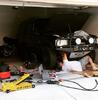
Just to close out this story I swapped out the starter this morning (after inspecting the wiring) and it fired right up no problems, so hopefully we are done with that! I actually took the “new” starter motor off of a long block I pulled from the wrecking yard this summer, looks like it was built/rebuilt a just a few years ago so that was good enough for me after a quick bench test. A couple of notes on the swap, in general it wasn’t too bad, a lot of people said the heat shield was the most difficult part but I didn’t find that to be the case, the most difficult part for me was holding the starter assembly in place while trying to bolt it on- it’s heavy when you arm is extended as far as it has to be!

Thread
Thread Starter
Forum
Replies
Last Post