


LR2 Front Differential Transfer Case Oil Drain Install Completed


Recovery Vehicle
Joined: Jul 2012
Posts: 832
Likes: 352
From: San Diego

I've never seen safety wire used on anything in cars. When there is any doubt that something like that will move, you use split washers. But because there is a liquid behind the bolt, teflon is not the correct solution, you use crush washers. But the crush washers are NOT reusable, when the bolt is taken out the crush washer must be replaced.
The teflon tape is immune to oil and heat, so might as well... I use it on any other NPT joints (ie plumbing).
Paul G machined out the hole to make room for washers and a plug with a lip, and ground the surface flat, that's another possibly better option:
https://www.freel2.com/forum/topic37065.html
But my solution is a simpler, quicker mod: drill, tap, and carefully install NPT plug (yes you need an NPT, not a straight thread, tap). Even easier if you drill the hole in the right place
 . The only "art" is torquing the NPT plug right. If you grind a flat face you have to of course get it nice and flat and smooth which might be beyond my artistic ability with a dremel.
I wouldn't use NPT for anything which would be R&R on a regular basis (example engine oil) because the threads will wear out with repeated use. For the PTU drain I'll probably only R&R once or twice in the remaining life of the vehicle. Can chase the threads, or worst case go one size larger.
Last edited by merlinj79; Jun 27, 2021 at 01:24 PM.

TReK
Joined: Jan 2020
Posts: 2,152
Likes: 631
From: Massachusetts
I used the safety wire to prevent catastrophic loss of oil if it worked loose from hot/cold cycles.
I use it on any other NPT joints (ie plumbing).
Last edited by flybd5; Jun 27, 2021 at 03:46 PM.

Rock Crawling
Joined: Dec 2015
Posts: 450
Likes: 336
When I reused this part I wrapped it in Teflon Tape
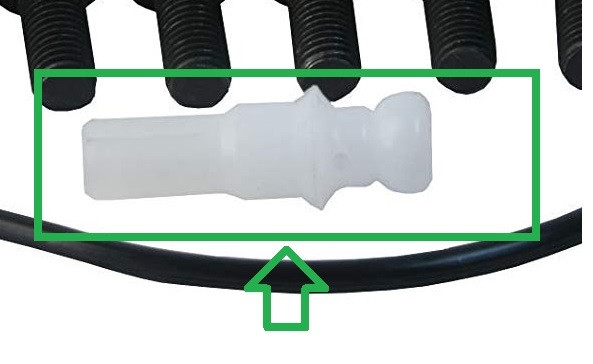
As far as sealing threads Land Rover sealed these threads with LOCTITE.
I do have some LOCTITE that will hold back hot coolant that is pressurized.
let me know if you want to know the number for the LOCTITE

If I still have a leak the next step for me will be to use the high durometer seal from the Transmission drain plug. This should seal better than the copper washer and in fact it would likely conform to the as cast surface.
Good luck
Paul
As far as sealing threads Land Rover sealed these threads with LOCTITE.
I do have some LOCTITE that will hold back hot coolant that is pressurized.
let me know if you want to know the number for the LOCTITE
If I still have a leak the next step for me will be to use the high durometer seal from the Transmission drain plug. This should seal better than the copper washer and in fact it would likely conform to the as cast surface.
Good luck
Paul
Last edited by p_gill; Jun 27, 2021 at 08:58 PM.
Recovery Vehicle
Joined: Jul 2012
Posts: 832
Likes: 352
From: San Diego
That's precisely why you use a crush washer, which when installed properly will adapt to the surface and seal. They're commonly found any time a threaded fastener has to seal in a liquid; the most common example is the crush washer under the oil drain plug of most cars. Tighten the bolt and the soft copper washer deforms to conform to and fill any gaps, making a liquid-tight seal.
The surface is too rough and uneven, and since the case is aluminum I'd have to torque it far more than would be remotely prudent to maybe get a seal. If it was a steel drain pan, yeah I might have tried that with some RTV on the washer.
I have spent 40+ years using safety wire. That is not why they are used. Hot/cold cycles will not make a fastener "work itself loose". Large vibration (such as fasteners used on aircraft) or rotational forces (as on the bolts used to install a propeller) will. If you check you will see that not a single car engine manufacturer uses safety wire on their engines. As I said, you use split washers for that, which are specifically designed to make sure the fastener does not work itself loose. The other reason is that to use safety wire properly, the bolt head has to be drilled and there has to be another nearby drilled bolt or surface with some orifice so that you can secure the other end of the safety wire. Not to mention that most people don't have a clue how to properly install safety wire.
Come on, man, this is not your home's plumbing... There's a good reason no one uses Teflon in cars. Have you ever seen any teflon in any bolt, seal, metal tube joint or anything else in a car? Teflon tape is not just a thread sealant, but also a thread lubricant. In essence you are putting a material on the plug that will make it easier for it to be removed, or what you say you are trying to avoid, coming off on its own.
NPT is used where you want a seal from the threads, without resorting to orings, gaskets, etc. NPT is not "normally" used on cars because it doesn't hold up to repeated R&R (like an oil drain plug). So on vehicles, they just machine a surface for a washer/oring to seal. I didn't want to do that, it looked like a PITA to get flat and also I simply don't know if I could remove enough material around the sides to allow a drain plug lip to fit. Paul is more dedicated than I am.
Thread lube is important for NPT fittings to
1) guarantee a fluid seal and
2) not corrode so as to be removable later (brass & aluminum have a galvanic thing going on).
It will not allow the fitting to work loose. My concern with it working loose was due to not having engineering numbers or an exact torque value to use (NPT is almost always torqued by feel, only exception would be specific industrial applications where quality control is very precise).
Again, it's an experimental work-around to JLR's failure to provide for routine mx. I'm not necessarily recommending it especially since there's some art to torquing an NPT taper fitting.
Last edited by merlinj79; Jun 28, 2021 at 09:39 AM.

Rock Crawling
Joined: Dec 2015
Posts: 450
Likes: 336

If you look at my stackup I am using
1. Copper washer
2. Dowtry washer
3. Copper washer
On my son's VW when I changed the motor oil the aluminum washer was offset and it didn't seal. This was the first time in a long time that I did an oil change and it leaked out of the drain plug. I inspected the Aluminum crush washer and it was severely deformed by the steel pan and it wasn't sealing. To prevent this there are two options. One hold the washer in position while tightening. Two apply more torque so that the washer is deformed enough to seal. I initially went with the first option. To prevent this from happening in the future I purchased DOWTY washer and I installed on on the drain plug and then the Aluminum washer.
The team at VW didn't do a good job with the tolerance stack up.
Welcome to FMEA (Failure Modes Effect Analysis)
Note: the DOWTY washer works and all is well in the universe.
Take care
Paul
PS Your comments gave me flashbacks "Paul is more dedicated than I am."
all I could think is
HIGHLY MOTIVATED.........TRULY DEDICATED.......MORE PT DRILL SERGEANT......WE LIKE IT......WE LOVE IT......WE WANT MORE OF IT........
Last edited by p_gill; Jun 28, 2021 at 04:43 PM.
TReK
Joined: Jan 2020
Posts: 2,152
Likes: 631
From: Massachusetts
You two must have pissed off someone in a past life. I've changed my oil twice exactly as the manual states. Not a drop has leaked out in 18 months. Of course, I'm not drilling random holes in my oil pan or using parts from the plumbing section at Home Depot...

Thread
Thread Starter
Forum
Replies
Last Post