When you click on links to various merchants on this site and make a purchase, this can result in this site earning a commission. Affiliate programs and affiliations include, but are not limited to, the eBay Partner Network.
@XRAD - I wish I had measured my times before so I could compare. Anyways I am still in break-in so I haven't really stomped on it yet. My upgraded cam got me an extra 25 horses so I have never really experienced the sluggishness everyone talks about. I'll be testing it out a bit more once I get the steering fixed next weekend.
In the meantime, here's some good reading on Bill's website here about how the gearing brings you back into the optimal power band. Really a great read which helped me understand the benefits of this upgrade - especially after all the stuff we do to slow them down!
"Again, using a stock Rover V8 as an example, most of them work efficiently in the range of 2300/2400 rpms until about 4500 rpm. Do not confuse the higher number with the red line on the tachometer. The red line is maximum speed that the engine can operate safely. Exceed the red line for any length of time and the engine blows up!So what does this have to do with differential gearing? The manufacturer of the vehicle designed it (with stock differential gearing and stock tires) to operate most of the time within this efficient and ideal power band. The issue is that many off road modifications effectively “raise” the gearing of your Rover. One of the most common and best understood but certainly not the only modification that effectively raises the overall gearing is taller tires. Think of the earlier example we used, a 3.54 differential gear will still rotate the tires once for every 3.54 times the engine goes around but the taller tire will roll a longer distance. So at the same engine speed, your miles per hour or road speed will go up, hence to maintain, say the legal speed limit, you need to drop the engine speed. This is where the gearing problem starts. When you drop your engine speed below 2300/2400 rpm, you exit the power band and start suffering the consequences of it.
Conversely, when you are accelerating from a standing stop, it takes you longer to reach the power band. So what are the real live consequences of being geared incorrectly? Before we get into that, there is a characteristic of most late model Land Rovers Range (Rover Classics, all Discoverys and NAS Defender 90s) that is important to know. That is that they are geared a bit on the tall side, meaning that in stock form they are geared correctly but you don’t have much reserve gearing. The result of this is it is easy to go from being geared correctly to being over geared. One way to do this is to install taller tires and presto – over geared."
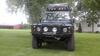
Updated my cost spreadsheet for folks to view. My goal with this is to show people how carried away you can get if you aren't careful! Probably will get it painted and replace some plastic trim which should bring the total cost to ~$30K!!!
an ongoing drain on financial resources, such as a house in frequent need of costly repairs or improvement.
"your bargain fixer-upper need not become your money pit"
Yeah you are more brave than I am. I don’t want to know what I’ve spent, but you still can’t get anything like a disco for even $30k. And if your bored during a pandemic it’s a great time user!
Thx for reply CV! agree on costs....I was going to sell my black 01, but decided that the 20g's in parts I just put into it are worth more than I'll ever get for it, so it will be the donor for my silver 04.....
Stick with the insanity! There are lots of cheap, non-rusted ones down in FL. Find one you like and if it is in area, I'm happy to check it out for you!
Updated my cost spreadsheet for folks to view. My goal with this is to show people how carried away you can get if you aren't careful! Probably will get it painted and replace some plastic trim which should bring the total cost to ~$30K!!!
On the latest episode of “How much can you spend on your Disco?” I worked on replacing the track rod and the drag link. Seemed to go in easy enough and it’s a lot beefier than OEM. While was under there, I decided to remove the forward cross member. A couple of the bolt heads got stripped in the process so I had to improvise with a impact driver and an Irwin bolt extractor. The alignment is messed up a bit so I will take it to the shop tomorrow to get that done. Front in Drag link in My Irwin improvisation
Normally, l measure from center of each tie-rod (where grease zert is located, if it has them or not) on old track/tie-rod bar...then apply that diamention to the new track/tie-rod bar. This should keep you close or spot on, if it was right to begin with.
You basically only have toe adjustment, which is handled by adjusting track bar. Just measure from inside of each tire, sidewall to sidewall, keeping the tape measure as level as possible, front and back. Usually, l set toe at about an 1/8 inch, front diamention less, suspension mostly unloaded on jack stands. Once the vehicle is lowered and weight loads the suspension...it's usually around 1/16 toe-in or neutral. Once you get toe set, adjust drag-link bar until steering wheel is straight. This is my personal preference, l believe, factory setting for toe is 1/16 toed-out...front diamention greater. Which makes no sense to me, since the tires are hunting opposite directions...especially if more load is added by the compression of the suspension over rough terrain...instead of both working slightly towards center of lane...if toed in. But hey...who am l to argue with british engineering...lol.





 Probably will get it painted and replace some plastic trim which should bring the total cost to ~$30K!!!