


PCV Buzz?


 PCV Buzz?
Buzz, in another thread you wrote:
If the flow was reversed, would this be what the inside of the throttle body would look like?
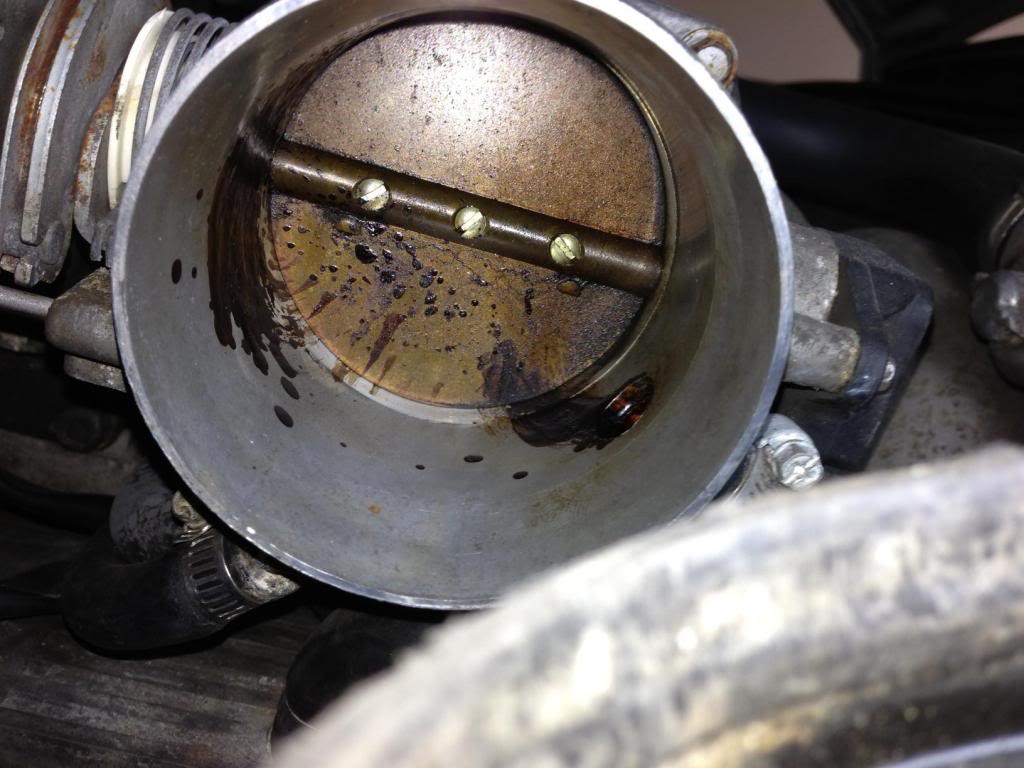
Driver side PCV line does not have the filter. Normally filtered air from the throttle body is drawn thru the engine, picks up oil fumes, and out the passenger side valve cover and "oil separator" to intake manifold. Under some conditon flow reverses, and driver side valve cover vents oil fumes into throttle body.

Super Moderator
Joined: Jan 2011
Posts: 16,322
Likes: 88
From: Savannah Georgia
Yep. Think about it, no fuel is introduced until way past the butterfly valve. The PCV system is the source, if the passenger side is restricted the vac from the throttle body will slurp it right in on the driver side. You can spray that and use a rag on a stick to wipe up most of it behind the throttle plate. Would not want a big puddle sucked into intake. And through the bores that link to IACV and the PCV hose line. SeaFoam if you like also, but do outside, never in a garage or near a door where the smoke can get to a smoke detector inside.
Ok, I did clean the throttle bottle a couple of weeks ago but snapped this picture before I did. I was meaning to post it up and asked if it seemed normal. Now it makes sense. So is your advice to do a seafoam induction? Or can I just remove the passenger side hose and clean it out?
Buzz?? The RAVE says this:
But you say the normal flow is OUT of the throttle body? So which is it?? Am I now chasing a phantom problem that doesn't exist?! 
Crankcase ventilation
A positive crankcase ventilation system is used to vent crankcase gases to the air induction system. Gases are drawn from the left hand rocker cover to a tapping in the throttle body. An oil separator is incorporated in the hose connection stub pipe in the right hand rocker cover, gases from this connection are drawn to a tapping in the inlet manifold.
A positive crankcase ventilation system is used to vent crankcase gases to the air induction system. Gases are drawn from the left hand rocker cover to a tapping in the throttle body. An oil separator is incorporated in the hose connection stub pipe in the right hand rocker cover, gases from this connection are drawn to a tapping in the inlet manifold.
Super Moderator
Joined: Jan 2011
Posts: 16,322
Likes: 88
From: Savannah Georgia
If you look at the drawings in the RAVE, the filter air flows in from throttle body, through the oil galley areas, and out the PCV oil separator on the passenger side to the intake to be consumed with fuel. If it flowed out of both, at the same time, then a vacuum would be created inside the engine. The RAVE says this on page 267 of 1529 fo the D2 -
So if the plastic oil separator in the passenger side valve cover is gunked up, all flow will be thru the driver side. You can pull it out with pliers, or squirt carb cleaner in moderation down inside it.
When the engine is running in cruise conditions or at idle, manifold pressure is low and the majority of gases are drawn into the inlet manifold through the oil / vapour separator in the RH rocker cover stub pipe. At the same time, filtered air is drawn from the throttle body into the engine via the LH rocker cover.
During periods of driving at Wide Open Throttle (WOT), pressure at either side of the throttle disc equalizes (manifold depression collapses). The larger ventilation opening at the throttle housing positioned in the fast moving stream of intake air, now offers more 'pull' than the small opening in the RH rocker cover and the flow of ventilation reverses, drawing gases from the LH rocker cover into the throttle body for subsequent burning in the combustion chambers.
During periods of driving at Wide Open Throttle (WOT), pressure at either side of the throttle disc equalizes (manifold depression collapses). The larger ventilation opening at the throttle housing positioned in the fast moving stream of intake air, now offers more 'pull' than the small opening in the RH rocker cover and the flow of ventilation reverses, drawing gases from the LH rocker cover into the throttle body for subsequent burning in the combustion chambers.
So if the plastic oil separator in the passenger side valve cover is gunked up, all flow will be thru the driver side. You can pull it out with pliers, or squirt carb cleaner in moderation down inside it.
Last edited by Savannah Buzz; May 23, 2013 at 09:04 PM.

Pro Wrench
Joined: Apr 2008
Posts: 1,475
Likes: 37
I agree with buzz completely, however, if the separator is clogged, it's not a reversal of air flow, as you do not have clean air going to the crankcase at all, so you end up with too much crankcase pressure when at idle.
Also, the picture you posted looks more like one big splat, as opposed to a constant flow of crankcase gases at that point. This would mean you had a (most likely sludgey) restriction on that side too, and once pressure built up enough, it was pushed through.
Also, the picture you posted looks more like one big splat, as opposed to a constant flow of crankcase gases at that point. This would mean you had a (most likely sludgey) restriction on that side too, and once pressure built up enough, it was pushed through.
Super Moderator
Joined: Jan 2011
Posts: 16,322
Likes: 88
From: Savannah Georgia
True, you are just evacuating the engine case vapors, most likely only at WOT. So more gunk. It is correct that there is no alternate air intake path. My throttle body PCV port was blocked with what looked like wheel bearing grease. With the oil separator blocked, oil fumes stay in the motor, except when enough pressure plus suction at WOT draws them toward the throttle plate. More gunk for all surfaces. No warning lights or codes.
Last edited by Savannah Buzz; May 24, 2013 at 07:28 PM.

Thread
Thread Starter
Forum
Replies
Last Post

